Futures
Topic: Consumer Skepticism and Misinformation
Summary
Misinformation remains a significant threat to democracy, as highlighted by recent studies showing that a small group of individuals, termed “supersharers,” is responsible for the majority of fake news dissemination on social media. These studies reveal that misinformation, particularly regarding vaccines, can significantly influence public behavior and attitudes. The findings emphasize the need for effective strategies to combat misinformation, especially among demographics that are more likely to share false information.
The precarious state of democracy is further exacerbated by the rise of synthetic media, including deepfakes, which pose new challenges for information authenticity. A report from Europol warns that by 2026, a substantial portion of online content could be artificially generated, raising concerns about the implications for artists and the broader media landscape. This shift towards synthetic media contributes to a growing skepticism about the authenticity of digital content, leading to what is termed “deep doubt.” This skepticism can undermine trust in genuine events and evidence, complicating the public’s ability to discern fact from fiction.
In response to the challenges posed by misinformation, some countries are taking proactive measures. Finland has integrated digital literacy and fact-checking into its school curriculum, aiming to equip students with the skills necessary to navigate online information critically. This educational approach emphasizes the importance of teaching children to be their own fact-checkers, fostering a culture of skepticism and critical thinking that can help combat misinformation in the long run.
The rise of AI technologies also plays a dual role in this landscape. While AI systems can generate content that mimics human creation, they also raise concerns about the reliability of information. The potential for AI-assisted scams and the manipulation of public sentiment through bot farms highlight the need for vigilance and ethical considerations in the deployment of these technologies. Experts warn that the rapid advancement of AI could lead to increased misinformation and manipulation, necessitating a reevaluation of current policies and practices.
The impact of technology on society extends beyond misinformation. The polarization of communities, fueled by social media, has led to a call for more meaningful political engagement. Critics argue that online interactions often distract from real-world action, perpetuating apathy and division. Building trusted networks and fostering community organizing are seen as essential steps toward addressing local issues effectively.
In authoritarian contexts, the use of disinformation as a political tool is particularly pronounced. Reports from Bangladesh reveal that pro-government outlets are leveraging AI to produce deepfake videos and spread false narratives against opposition parties. This coordinated effort underscores the intersection of disinformation and authoritarianism, where the ruling party seeks to manipulate public opinion and suppress dissent.
Finally, the discourse surrounding technology and its implications is shifting. The initial optimism surrounding AI is giving way to skepticism as the public becomes more aware of its potential harms. Critics argue that blind trust in technology can lead to overlooking significant risks, emphasizing the need for critical thinking and a cautious approach to technological advancements. The ongoing debate about the role of AI in society reflects broader concerns about power dynamics and the ethical implications of emerging technologies.
Seeds
| name | description | change | 10-year | driving-force | |
|---|---|---|---|---|---|
| 0 | Rise of Internet Grifters | An increase in internet scams and disinformation campaigns as political tools. | Shift from traditional politics to online manipulation and grifting. | Internet platforms will struggle to regain trust as grifters manipulate political discourse. | The overwhelming access to information online promoting distrust in conventional media. |
| 1 | Cultivation of Anti-Establishment Sentiment | Skepticism toward doctors and healthcare fuels anti-establishment views. | Incremental doubt toward medical professionals to open disdain and rejection. | A polarized public health environment, leading to differentiated health practices. | Erosion of trust in scientific and medical communities post-pandemic. |
| 2 | Trust in Digital Content Erosion | Erosion of trust in online content as synthetic media becomes pervasive. | Shifting from trust in traditional media to skepticism towards digital content. | Audiences will rely on verification tools and critical thinking to assess content authenticity. | Increased awareness of misinformation and the capabilities of synthetic media. |
| 3 | Disinformation Concerns | Growing concerns about disinformation driven by deepfake technology. | Shift from traditional disinformation tactics to sophisticated AI-generated misinformation. | Information ecosystems will require new frameworks to combat and verify authenticity. | The ongoing battle against misinformation and the need for public awareness. |
| 4 | Ineffectiveness of Content Flagging | Flagging misinformation is less effective than previously assumed. | Shift from reliance on flagging false content to understanding broader misinformation impacts. | Future platforms may develop new strategies beyond flagging to combat misinformation. | The realization of flagging inadequacies in controlling misinformation flow. |
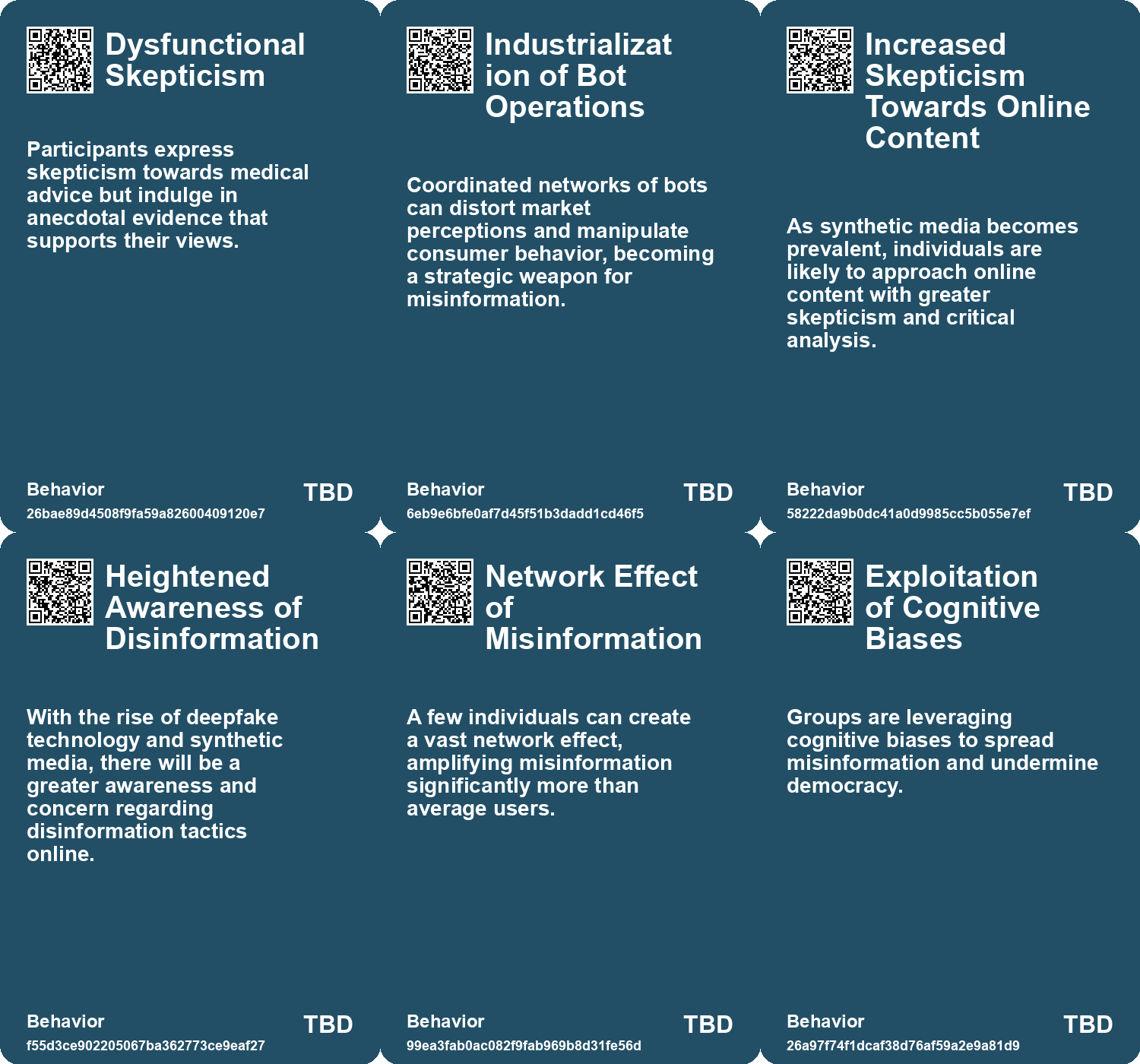
| 5 | Exploitation of cognitive biases | Groups exploit cognitive biases in humans to spread misinformation. | Shift from democratic discourse to manipulation through psychological tactics. | Democracy may struggle as misinformation becomes more sophisticated and widely accepted. | Increasing sophistication of technology and understanding of human psychology. |
| 6 | Deep Doubt Era | Increasing public skepticism towards the authenticity of media due to AI-generated content. | Shift from trust in media to widespread skepticism about the authenticity of visuals. | In 10 years, media consumption may prioritize transparency and verification tools over traditional sources. | The proliferation of advanced AI tools that enable easy creation of convincing fake media. |
| 7 | Conspiracy Theories Amplification | Rise in conspiracy theories fueled by AI-generated media and deep doubt. | Shift from skepticism towards specific events to broader distrust in all media narratives. | Conspiracy theories may become mainstream, affecting public trust in institutions and media. | The intersection of technology, misinformation, and social media dynamics. |
| 8 | Misinformation Overload | The rise of AI-generated content leads to an overwhelming volume of misinformation. | Shift from occasional misinformation to a pervasive ocean of false information. | Society may struggle to discern truth in a landscape dominated by AI-generated misinformation. | The ease of producing large volumes of content using AI tools encourages the spread of misinformation. |
| 9 | Rise of Misinformation Awareness | Increased awareness of misinformation spread through digital platforms. | Growing recognition of misinformation as a significant societal issue. | Stronger emphasis on digital literacy and critical evaluation of information sources. | The overwhelming volume of information available online necessitating discernment. |
Concerns
| name | description | |
|---|---|---|
| 0 | Propagation of Misinformation | The prevalence of lies and absurdities online diminishes the media’s ability to effectively filter information, leading to widespread misinformation. |
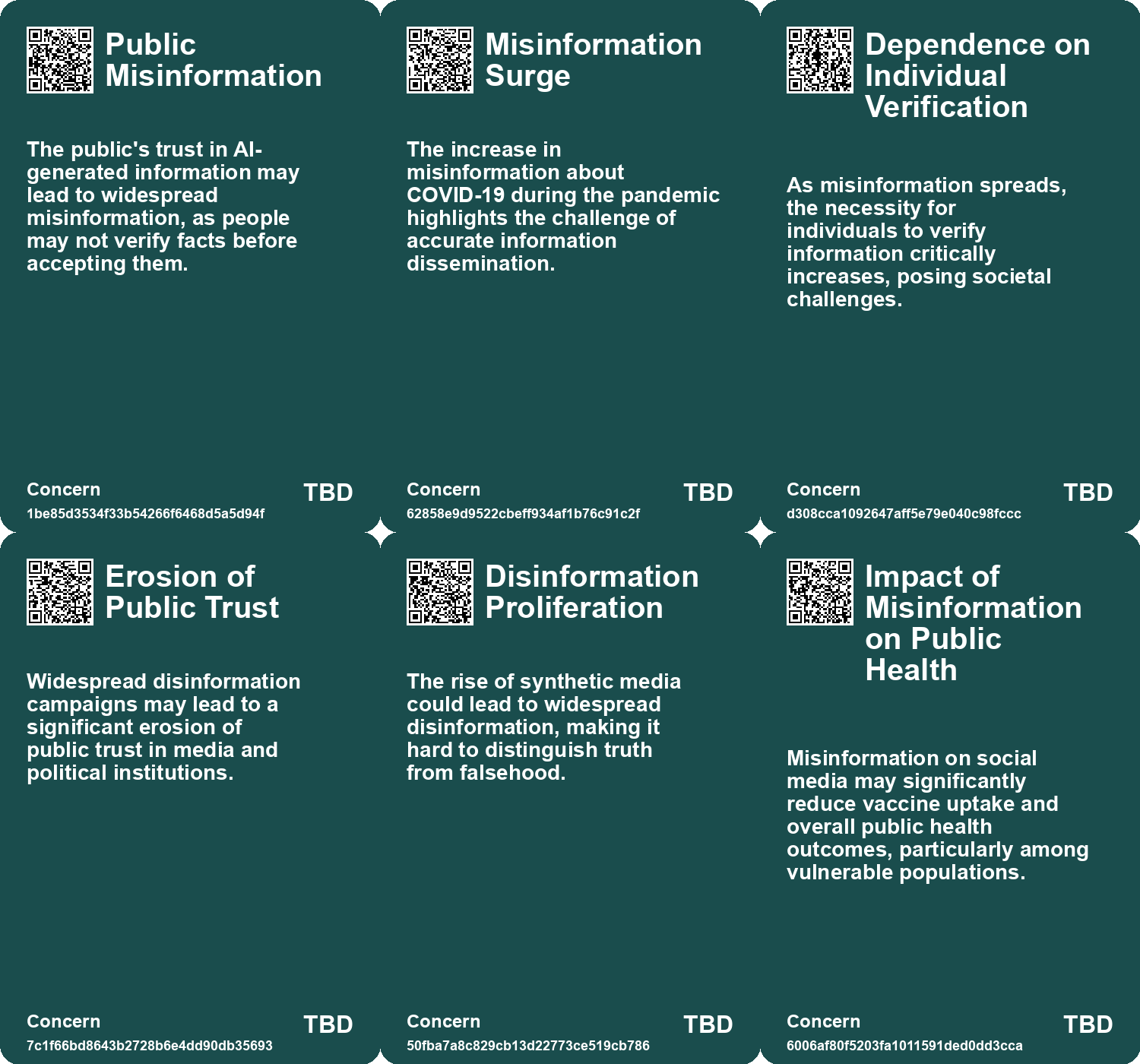
| 1 | Public Misinformation | The public’s trust in AI-generated information may lead to widespread misinformation, as people may not verify facts before accepting them. |
| 2 | Misinformation Surge | The increase in misinformation about COVID-19 during the pandemic highlights the challenge of accurate information dissemination. |
| 3 | Dependence on Individual Verification | As misinformation spreads, the necessity for individuals to verify information critically increases, posing societal challenges. |
| 4 | Erosion of Public Trust | Widespread disinformation campaigns may lead to a significant erosion of public trust in media and political institutions. |
| 5 | Impact of Misinformation on Public Health | Misinformation on social media may significantly reduce vaccine uptake and overall public health outcomes, particularly among vulnerable populations. |
| 6 | Demographic Targeting in Misinformation | The predominance of specific demographics among misinformation spreaders may exacerbate existing social and political divides. |
| 7 | Exploitation of Cognitive Biases | Manipulation of psychological biases through disinformation can distort public perception and decision-making. |
| 8 | Immunization Against Misinformation | The lack of immunity activators for cognitive health could result in increased susceptibility to misinformation. |
| 9 | Increased Conspiracy Theories | The prevalence of ‘deep doubt’ fuels conspiracy theories, as people may dismiss factual events as AI fabrications, leading to misinformation. |
Cards
Concerns
Behaviors
Issue
Technology
Links
- The Perils of Expertise: How Assumptions Can Hinder Market Understanding
- Harvard Scholars Advocate for AI in Political Polling Amid Declining Human Engagement
- Europol Report Warns of Rising AI-Generated Content and Disinformation Risks
- Exploring the Modern Entertainment Landscape and Its Societal Implications
- The Freedom Summit: A Rallying Cry for Anti-Vaccine Sentiments and Medical Distrust
- Exploring the Rise of ‘Deep Doubt’ Amidst AI-Generated Media Content
- Finland’s Innovative Approach to Combating Fake News Through Education
- The Backlash Against Lina Khan: A Fight for Consumer Protection and Antitrust Reform
- Google’s Transition to Remote Work and the Evolution of Information Security
- Exploring the Dangers of Manipulated Machine-Learning Models and Their Impacts on Society
- The Impact of the Internet and AI on Human Cognition and Productivity
- The Rise of Industrialized Sentiment Manipulation and the Need for Digital Identity Verification
- Addressing Threats to Democracy: Strategies for Resilience Against Misinformation and Manipulation
- Understanding the Techno-Optimist’s Fallacy and its Implications for Technology Regulation
- Emerging Trend: Foreign-Origin Accounts Spreading Disinformation on Social Media.
- The Dual-edged Sword of AI: Misinformation and Societal Threats in the Age of Advanced Language Models
- The Illusion of Online Activism in the Age of Trump: Embracing Real-World Action Instead
- Exploring the Ordinary Origins of Surveillance: Insights from Hochman and González’s New Books
- AI Workers Share Ethical Concerns and Distrust Over Generative AI Reliability and Safety
- A Personal Account of Falling Victim to a Phone Scam and Its Implications for Banking Security
- Bangladesh’s Disinformation Campaign: The Role of AI and Deep Fakes in Elections
- The Impact of Supersharers on Vaccine Hesitancy and Fake News Spread on Social Media
- Shifting Perspectives: The Growing Skepticism Towards AI and Its Implications
- The Vital Role of Dissent in Effective Decision-Making for Organizations
- Understanding Polarization: Healing Our Relationship with Technology and Embracing Diverse Perspectives