Futures
Topic: Disruption of Traditional Economic
Summary
The current economic landscape is marked by a growing divide between traditional industries and the tech-driven sectors that once dominated. Progressive politics, once buoyed by influential figures in technology and media, now faces challenges as the importance of material goods resurfaces. Union militancy and class distinctions are widening, leading to potential conflicts between leftist activists and wealthy oligarchs. Meanwhile, the UK grapples with a severe economic crisis rooted in outdated policies that hinder housing and energy development, reflecting a broader struggle for growth in many regions.
The concept of a “casino economy” highlights the dominance of financialization, where short-term gains overshadow traditional growth. This K-shaped recovery illustrates a stark contrast between the wealth accumulation of the top tier and the struggles of the lower class. As younger generations face rising interest rates and food insecurity, the connection between materialism and spirituality emerges, with people seeking solace in the stock market amid uncertainty.
Amidst these economic challenges, the idea of degrowth gains traction as a response to climate change and ecological breakdown. Advocates argue for scaling down destructive production and focusing on human needs, emphasizing the need for policies that support sustainable development. However, transitioning to a degrowth model faces significant obstacles, including political opposition and dependencies on growth.
Infrastructure plays a critical role in shaping societal outcomes, with its degradation leading to disasters and perpetuating social inequality. Historical examples illustrate how infrastructure development has influenced colonization and revolutionary movements, underscoring the need for sustainable planning.
The rise of monopolistic practices, termed “economic termites,” highlights the hidden costs of monopolization across various industries. These practices inflate costs and create barriers for new competitors, emphasizing the need for promoting competition to restore fair commerce.
As the landscape of work evolves, traditional job structures are breaking down. The shift towards modular and unbundled roles due to technological advancements calls for new support systems that prioritize meaningful work and economic security. This transformation is further complicated by the rise of automation, which, while creating new opportunities, also necessitates ethical guidelines to ensure its benefits are widely shared.
Finally, the reshuffling of land ownership and the implications of climate change underscore the need for innovative land reform. As societies navigate these changes, rethinking property rights could promote social equity and address future challenges. The potential decline of the U.S. dollar as the global reserve currency raises questions about the future of monetary policy and public confidence in institutions, suggesting a significant shift in the global economic order.
Seeds
| name | description | change | 10-year | driving-force | |
|---|---|---|---|---|---|
| 0 | Concerns Over Automation and AI Impact | There is growing unease about the effects of job automation on the economy. | Increased dependence on automation leads to job loss concerns and industry shifts. | Labor markets will evolve dramatically, with a substantial percentage of jobs replaced by AI. | Rapid technological advancements surpassing worker capability and adaptation. |
| 1 | Decentralization of Employment | Traditional employment structures are fracturing, creating new networks of independent work. | Shift from centralized job structures to decentralized, modular systems of work. | Work will become more networked, with portable benefits and flexible support systems. | The rise of AI and automation is reshaping labor needs and employment structures. |
| 2 | Shift in Social Stability Framework | The reliance on jobs for social stability is weakening, leading to new frameworks. | Moving from jobs as a primary means of stability to alternative support structures. | New systems will emerge to provide economic security beyond traditional roles. | The evolving relationship between work, identity, and social security shapes new stability needs. |
| 3 | Decorp Culture | Rejection of corporate values, with younger generations subverting traditional ideals of success. | Shift from corporate aesthetics to anti-establishment cultural expressions in fashion and lifestyle. | By 2034, the concept of success may be redefined towards inclusivity and authenticity rather than traditional markers. | The inaccessibility of traditional paths prompts consumers to seek alternate definitions of success and identity. |
| 4 | De-globalization in Trade | Shift away from global supply chains towards localized trading practices. | Moving from globalized trade models to localized, ‘friendshoring’ strategies. | In 2033, businesses may operate predominantly within localized markets, reducing global trade dependency. | Emerging global conflicts prompting companies to reassess supply chain strategies. |
| 5 | Rise of Alternative Financial Technologies | New financial technologies are emerging in unregulated spaces, affecting infrastructure access. | Shift from traditional banking to mobile financial services in underserved areas. | In 10 years, mobile financial services may dominate in areas with limited bank access. | The need for accessible financial solutions in underserved populations. |
| 6 | Social Fissures from Energy Inequality | Energy consumption disparities are creating social divides and tensions. | From equitable energy access to significant disparities based on consumption and resources. | In 10 years, energy policies may prioritize equity and sustainability in access. | Growing awareness of energy equity and its impact on social cohesion. |
| 7 | Shift in Economic Power | Traditional industries are regaining importance over tech and media sectors. | From a tech-driven economy to a resurgence of traditional industries like manufacturing and agriculture. | In a decade, traditional industries may dominate the economic landscape, reshaping job markets. | The realization of dependency on material goods amid supply chain issues. |
| 8 | Secession of Ordinary People | A trend of ordinary people feeling disconnected and seceding from traditional political and economic structures. | From active participation in democratic and economic systems to a sense of alienation and withdrawal. | Potential emergence of new forms of grassroots governance and economic models that prioritize local involvement. | A growing perception of disenfranchisement and lack of control over societal structures. |
| 9 | Rising Global Uncertainty | Increased frequency and impact of uncertainty shocks affecting businesses worldwide. | Shift from stable economic environments to frequent uncertainty shocks influencing business strategies. | Companies will integrate uncertainty management into their core operations and strategic planning. | Growing geopolitical tensions and domestic political fragmentation are driving increased uncertainty. |
Concerns
| name | description | |
|---|---|---|
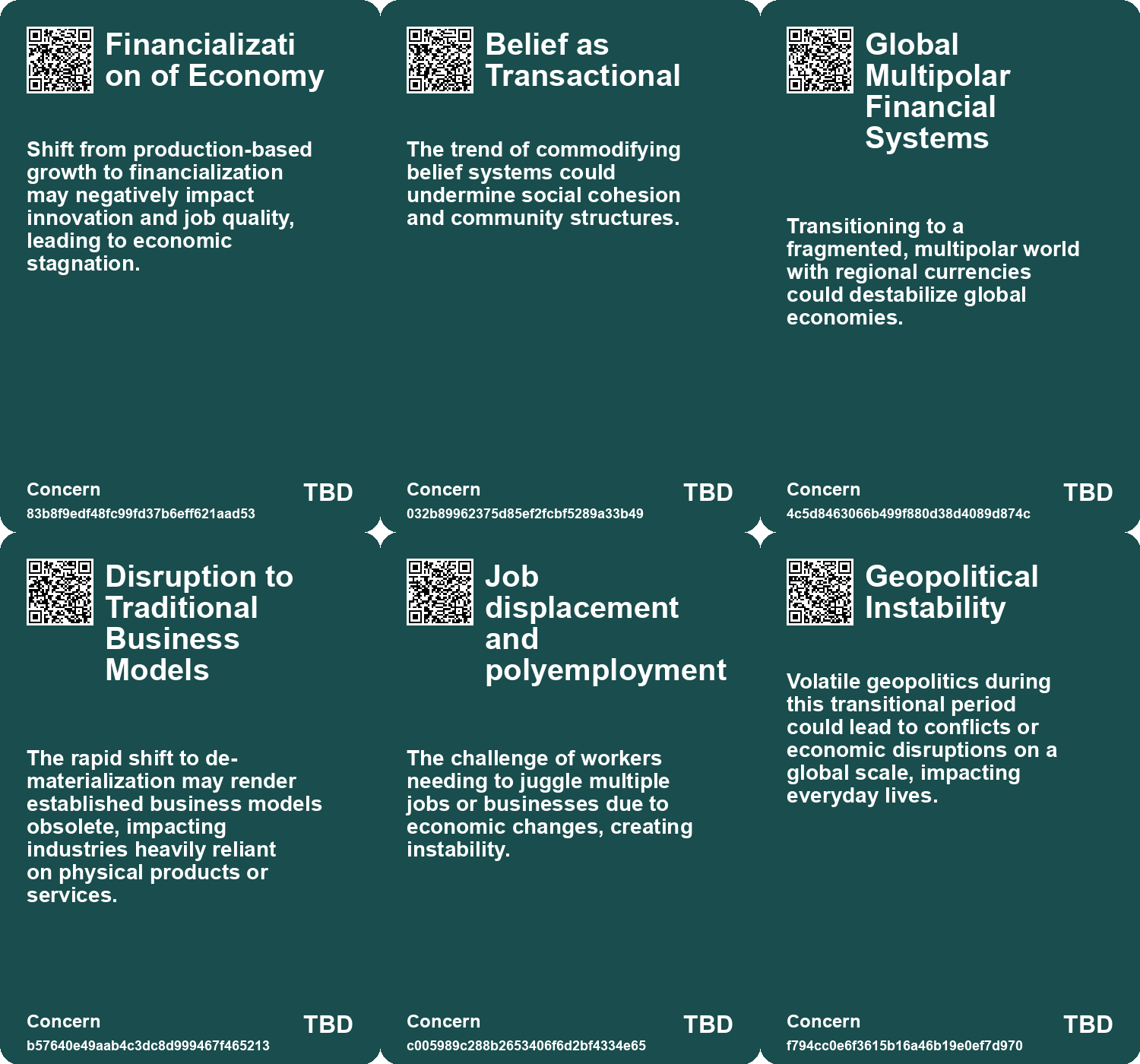
| 0 | Financialization of Economy | Shift from production-based growth to financialization may negatively impact innovation and job quality, leading to economic stagnation. |
| 1 | Belief as Transactional | The trend of commodifying belief systems could undermine social cohesion and community structures. |
| 2 | Global Multipolar Financial Systems | Transitioning to a fragmented, multipolar world with regional currencies could destabilize global economies. |
| 3 | Disruption to Traditional Business Models | The rapid shift to de-materialization may render established business models obsolete, impacting industries heavily reliant on physical products or services. |
| 4 | Job displacement and polyemployment | The challenge of workers needing to juggle multiple jobs or businesses due to economic changes, creating instability. |
| 5 | Geopolitical Instability | Volatile geopolitics during this transitional period could lead to conflicts or economic disruptions on a global scale, impacting everyday lives. |
| 6 | Restrictive Policies Against Environmental Goals | Existing political interests and economic structures may oppose the shift towards degrowth, leading to a lack of necessary policy changes. |
| 7 | Labor Market Instability | Shift towards blue-collar jobs and declining interest in traditional white-collar roles could destabilize job markets and working conditions. |
| 8 | Exodus of Businesses and Talent | Shift of businesses and individuals from progressive to conservative states may erode economic bases and further exacerbate social divides. |
| 9 | Geo-Economic Fragmentation | Increased political fragmentation leading to greater uncertainty in global economies, affecting business operations and planning. |
Cards
Concerns
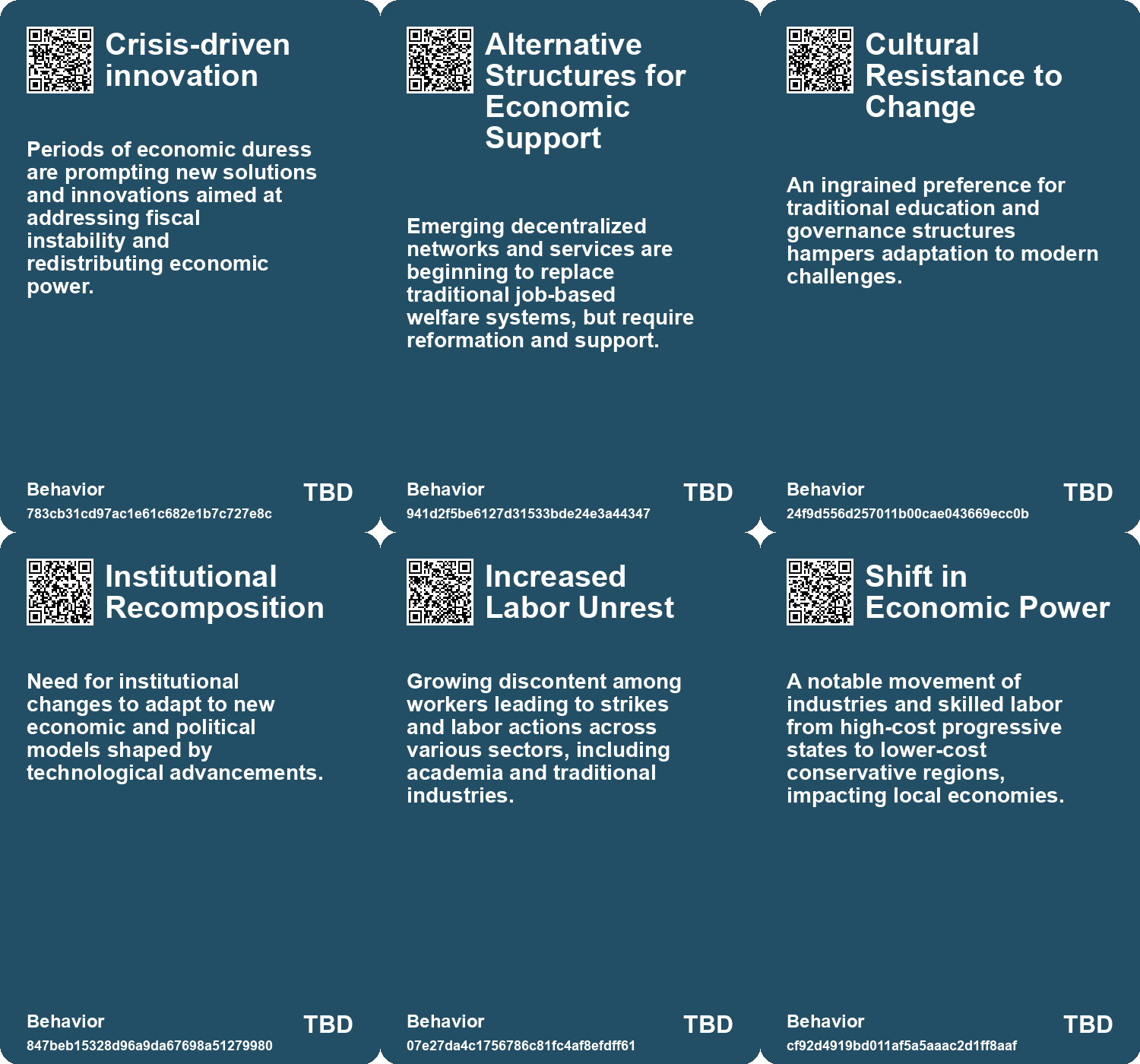
Behaviors
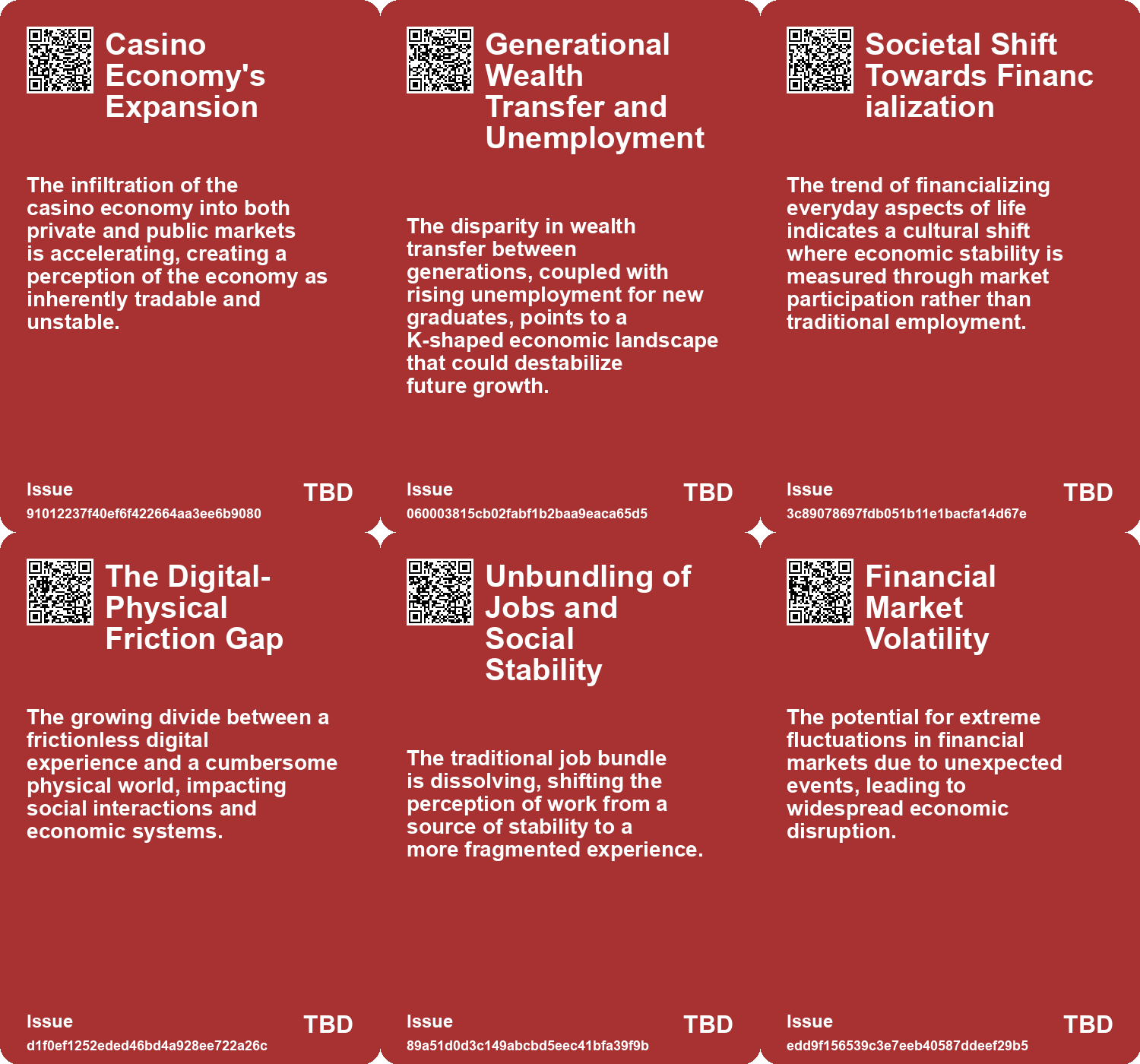
Issue
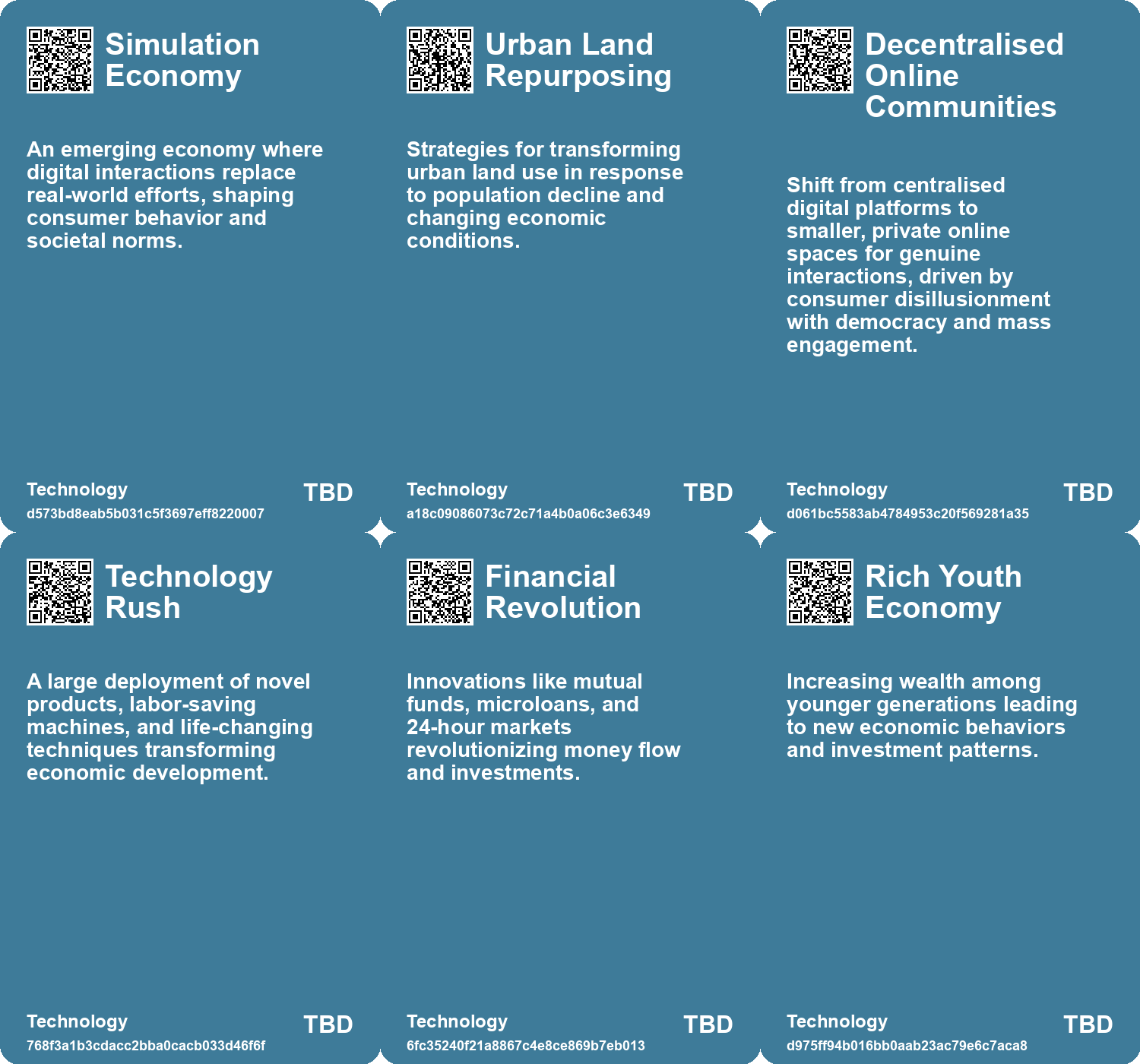
Technology
Links
- The Interplay of Democracy, Work, and Economic Justice in Modern Society
- Navigating Uncertainty Shocks: Strategies for Businesses in Turbulent Times
- The Decline of the U.S. Dollar: Predictions and Economic Insights Through 2040
- Exploring the Modern Entertainment Landscape and Its Societal Implications
- The Vision of Ultraprosperity: A Future of Economic Growth and Change
- Transformative Changes from 2014 to Today: AI, Energy, and Nationalism
- Rethinking Economic Growth: The Case for Degrowth in a Sustainable Future
- Exploring the Consequences of Abandonment in Rural Bulgaria and Nature’s Response
- The Unexpected Stagnation of Productivity Growth Post-Pandemic
- Exploring the UK’s Economic Crisis Rooted in Housing and Energy Shortages
- Understanding Economic Termites: Hidden Monopolies Driving Up Costs and Eroding Trust
- Exploring the Friction Economy: The Contrast Between Digital Ease and Physical Disarray
- Five Emerging Trends Transforming Business in the Coming Year
- Rethinking Jobs: From Manufacturing Nostalgia to Thriving Service Economies and Future Work
- Reimagining Infrastructure: Towards a Redistributive and Ecologically Sound Future
- The UK’s Declining Geopolitical Relevance and Elite Inaction: A Historical Perspective
- Empowering Artisanal Labor through Technology and Community Collaboration in Detroit
- The Unraveling of Progressive Politics: Economic Shifts and Growing Conflicts
- Exploring the Historical and Future Transformations of Land Ownership Worldwide
- The Promise and Risks of Automation: Creating Jobs While Navigating Challenges
- Future Trends Post-2024: Declining Democracies and Emerging Cultural Shifts
- Understanding the Casino Economy: How Financialization Shapes Our Lives and Beliefs
- Reimagining Work: The Shift from Job Bundles to Supportive Systems in the Age of AI