Futures
Topic: Polarization of Discussions
Summary
The intersection of technology and society remains a focal point in contemporary discourse, with many voices highlighting its dual nature. One perspective emphasizes the negative impact of digital technologies, particularly social media, on societal polarization. The call for a cultural shift towards a Talmudic approach—valuing multiple perspectives—suggests that a more thoughtful engagement with technology could mitigate its adverse effects. This notion resonates with critiques of online engagement, which argue that social media often distracts from meaningful political action, fostering apathy rather than community organizing.
Climate change emerges as another pressing theme, with discussions surrounding the complexities of public attitudes toward the crisis. The Polak Game serves as a tool to visualize these attitudes, revealing a spectrum from denial to radical change. The importance of social trust and community resilience is underscored as essential for addressing climate-related challenges. The need for effective energy policies and a deeper understanding of the moral implications of our responses to climate change is emphasized, highlighting the urgency of collective action.
The state of democracy is under scrutiny, particularly in light of misinformation and the tactics employed by groups that exploit social media. The spread of fake news, driven by a small group of “supersharers,” poses a significant threat to democratic processes. This concern is echoed in discussions about the normalization of radicalization online, where extreme sentiments overshadow nuanced discourse. The call for immunity activators, such as media literacy strategies and independent review bodies, aims to promote transparency and social cohesion.
In the realm of corporate governance, the debate over political neutrality among corporate leaders is gaining traction. The suggestion that corporations should adopt formal policies regarding political engagement reflects a growing concern about the potential alienation of stakeholders. This perspective aligns with the broader discussion of dissent in decision-making, where embracing diverse viewpoints is seen as crucial for improving organizational outcomes.
The evolving landscape of progressive politics is also highlighted, with challenges arising from economic shifts and class distinctions. The unraveling of the progressive economy raises questions about the future of leftist activism and its relationship with established elites. This tension is mirrored in the rise of populism, characterized by a rebellion against established systems, which is gaining traction in various political contexts.
The impact of misinformation extends beyond politics, affecting public trust and social interactions. Research indicates a decline in social engagement in urban environments, driven by technological changes and demographic shifts. The importance of designing public spaces that foster social capital and community ties is emphasized as a countermeasure to this decline.
Finally, the integration of digital literacy into education systems, as seen in Finland, presents a proactive approach to combating misinformation. By equipping students with critical thinking skills and fact-checking abilities, educational institutions can play a vital role in fostering informed citizens. This approach highlights the necessity of adapting curricula to address the challenges posed by misinformation and the digital landscape.
Seeds
| name | description | change | 10-year | driving-force | |
|---|---|---|---|---|---|
| 0 | Radicalization of Online Discourse | Online culture pushes users to adopt more extreme viewpoints for visibility. | Shift from nuanced discussions to extreme, polarizing rhetoric online. | Online discussions may predominantly feature radical extremes, marginalizing moderate voices. | Algorithms prioritize extreme content, leading users to conform for attention. |
| 1 | Pressure to Conform in Digital Communities | Users face pressure to adopt extreme viewpoints to avoid social ostracism. | From open discussion climates to environments that discourage moderation and complexity. | Online platforms may cultivate echo chambers with little room for dissent or nuance. | Increased community policing and behavioral norms enforced through social validation. |
| 2 | Erosion of Middle Grounds in Debate | Spaces for moderate and nuanced debate are decreasing rapidly online. | Shift from balanced discussions to highly polarized binaries in public discourse. | Debate platforms may lack representation of moderate viewpoints, fostering division. | Popularity of radical content discouraging rational dialogue and nuanced perspectives. |
| 3 | Subversion through Nuance as Resistance | Introducing nuance as a counter-narrative to extremism becomes a revolutionary act. | Transition from seeking attention via extremes to valuing thoughtful dialogue. | Possible resurgence of platforms valuing constructive discourse and complexity in interactions. | Growing fatigue with radical extremism prompting a shift towards balanced communication. |
| 4 | Embracing Dissent in Decision-Making | Encouraging dissent can improve decision-making by countering groupthink and biases. | Transitioning from valuing consensus to valuing dissent in organizational decision-making. | Organizations will incorporate formal dissent channels to ensure comprehensive perspectives are heard. | The need for better decision-making processes in increasingly complex environments. |
| 5 | Diversity of Opinions in Leadership | Leadership increasingly values diverse opinions through dissent. | Moving from homogenous decision-making to multi-faceted input in leadership structures. | Leadership teams will be more diverse and inclusive, actively seeking dissenting views. | A shift towards equity and inclusion in organizational practices. |
| 6 | Systematic Processing After Dissent | Exposure to divergent opinions stimulates deeper cognitive processing. | From shallow conformity to deeper analytical discussions based on differing viewpoints. | Workplaces will prioritize a culture that encourages critical thinking and dissent for better outcomes. | Demand for innovative solutions in competitive markets necessitates deeper analysis of ideas. |
| 7 | Increasing Polarization | Global societies are experiencing heightened polarization in political and social beliefs. | Shift from diverse ideological acceptance to increasing intolerance of opposing views. | In ten years, societies may become more fragmented, leading to isolated ideological communities. | Digital technologies and social media algorithms are fueling personalized information consumption. |
| 8 | Digital Echo Chambers | Social media creates echo chambers that reinforce existing beliefs. | Transition from open discourse to insulated ideological bubbles, limiting exposure to diverse views. | In ten years, public discourse may become dominated by polarized and unchallenged narratives. | Algorithms prioritize content that aligns with users’ beliefs, diminishing diverse perspectives. |
| 9 | Shifting Political Bias in AI Models | OpenAI’s ChatGPT shows a rightward shift in political bias over time. | From a perceived left-leaning bias to a measurable rightward shift in responses. | AI models may exhibit more diverse political biases, impacting user perception and trust. | Increased scrutiny and interaction with users may influence AI political perspectives. |
Concerns
| name | description | |
|---|---|---|
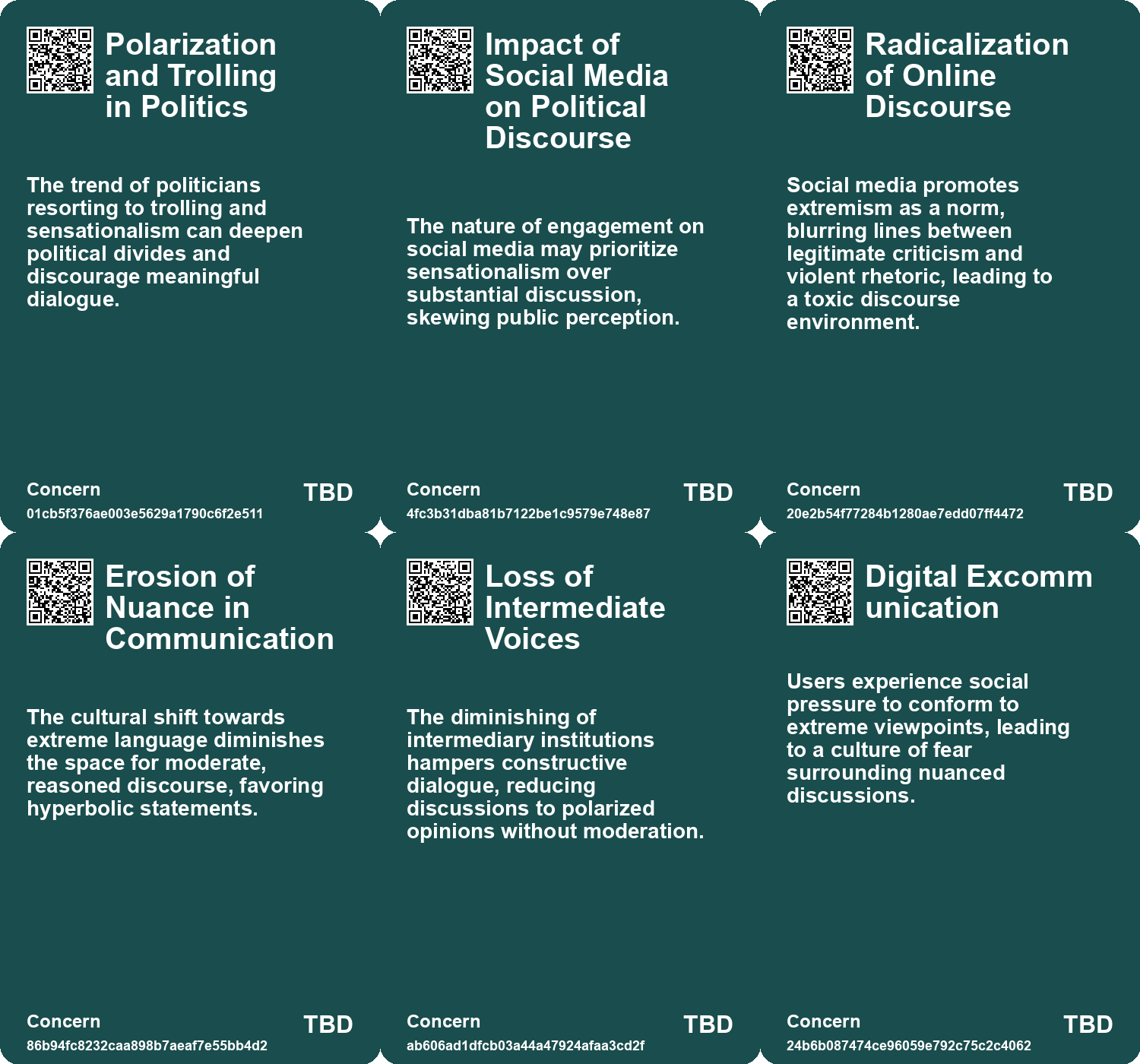
| 0 | Polarization and Trolling in Politics | The trend of politicians resorting to trolling and sensationalism can deepen political divides and discourage meaningful dialogue. |
| 1 | Impact of Social Media on Political Discourse | The nature of engagement on social media may prioritize sensationalism over substantial discussion, skewing public perception. |
| 2 | Radicalization of Online Discourse | Social media promotes extremism as a norm, blurring lines between legitimate criticism and violent rhetoric, leading to a toxic discourse environment. |
| 3 | Erosion of Nuance in Communication | The cultural shift towards extreme language diminishes the space for moderate, reasoned discourse, favoring hyperbolic statements. |
| 4 | Loss of Intermediate Voices | The diminishing of intermediary institutions hampers constructive dialogue, reducing discussions to polarized opinions without moderation. |
| 5 | Digital Excommunication | Users experience social pressure to conform to extreme viewpoints, leading to a culture of fear surrounding nuanced discussions. |
| 6 | Ineffective Decision-Making Structures | Traditional group discussions often fail to harness dissent effectively, resulting in unnecessary or biased decision-making processes. |
| 7 | Influencer Politics | Rise of political influencers shaping ideologies and mobilizing youth, potentially sidelining traditional political discourse. |
| 8 | Polarization of Society | Global trend of increasing political polarization, driven by digital communication methods, affecting democratic principles. |
| 9 | Corporate Political Neutrality | The shift towards political neutrality in corporations could limit free expression and diverse viewpoints, potentially stifling important social discussions. |
Cards
Concerns
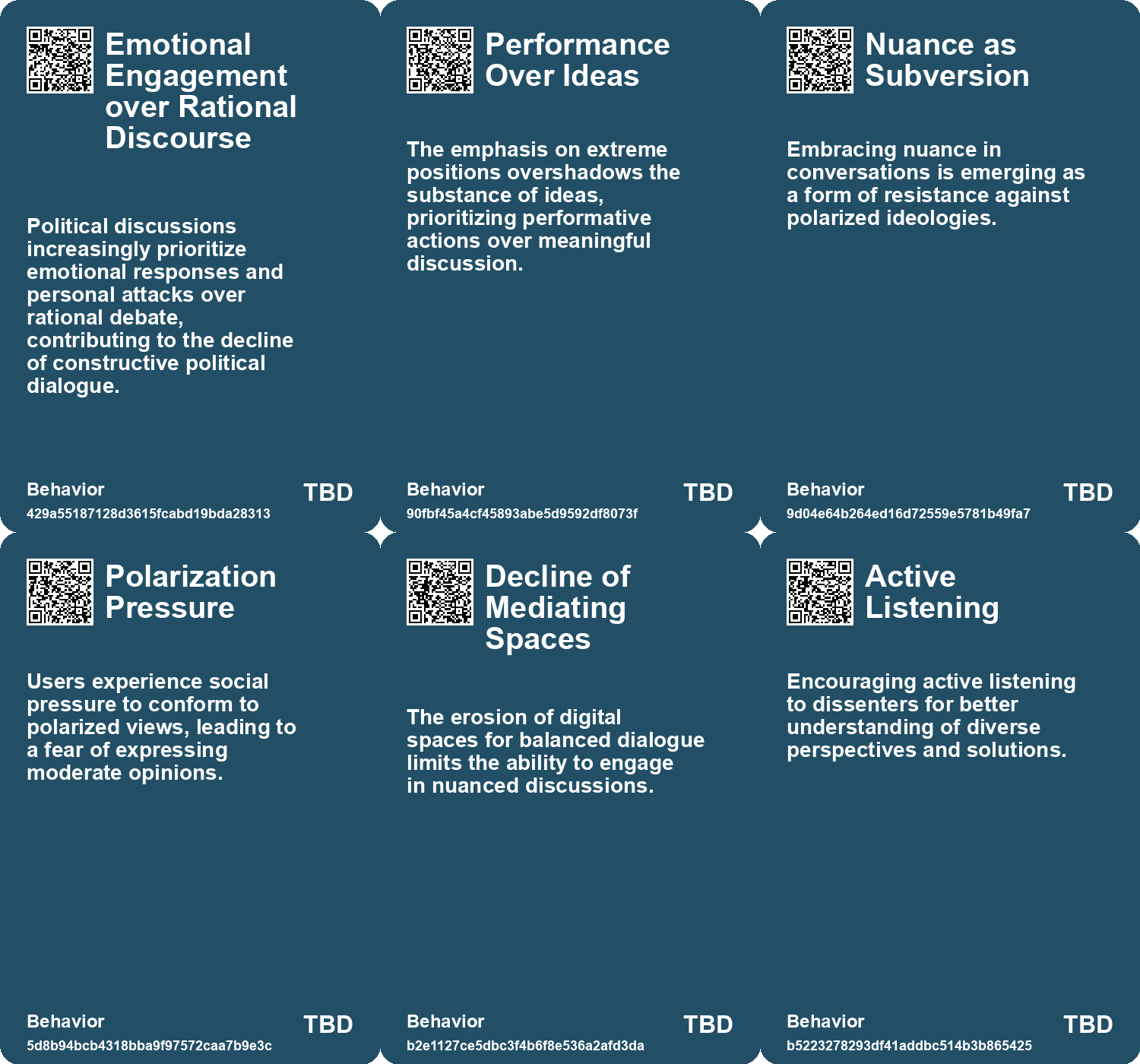
Behaviors
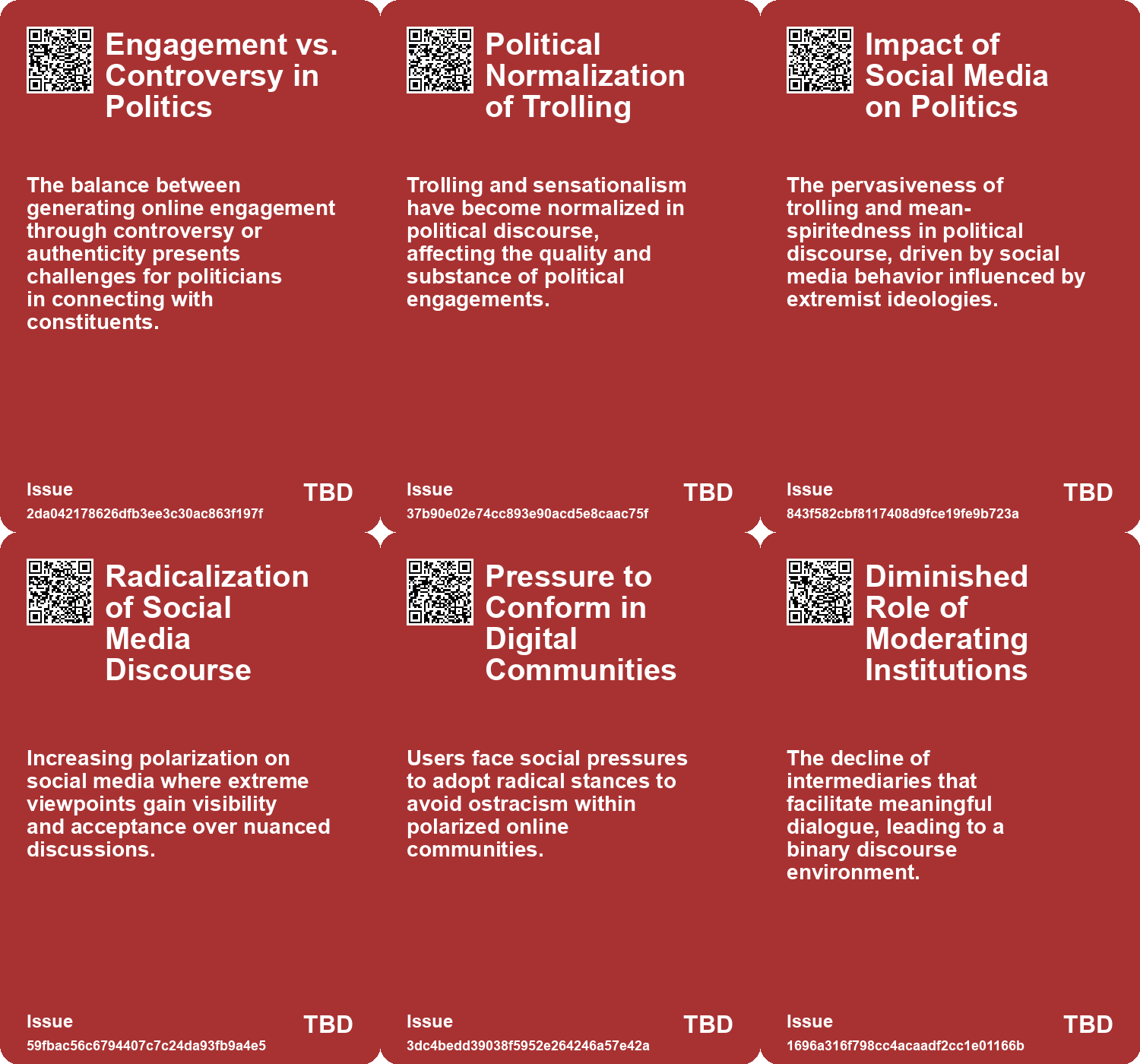
Issue
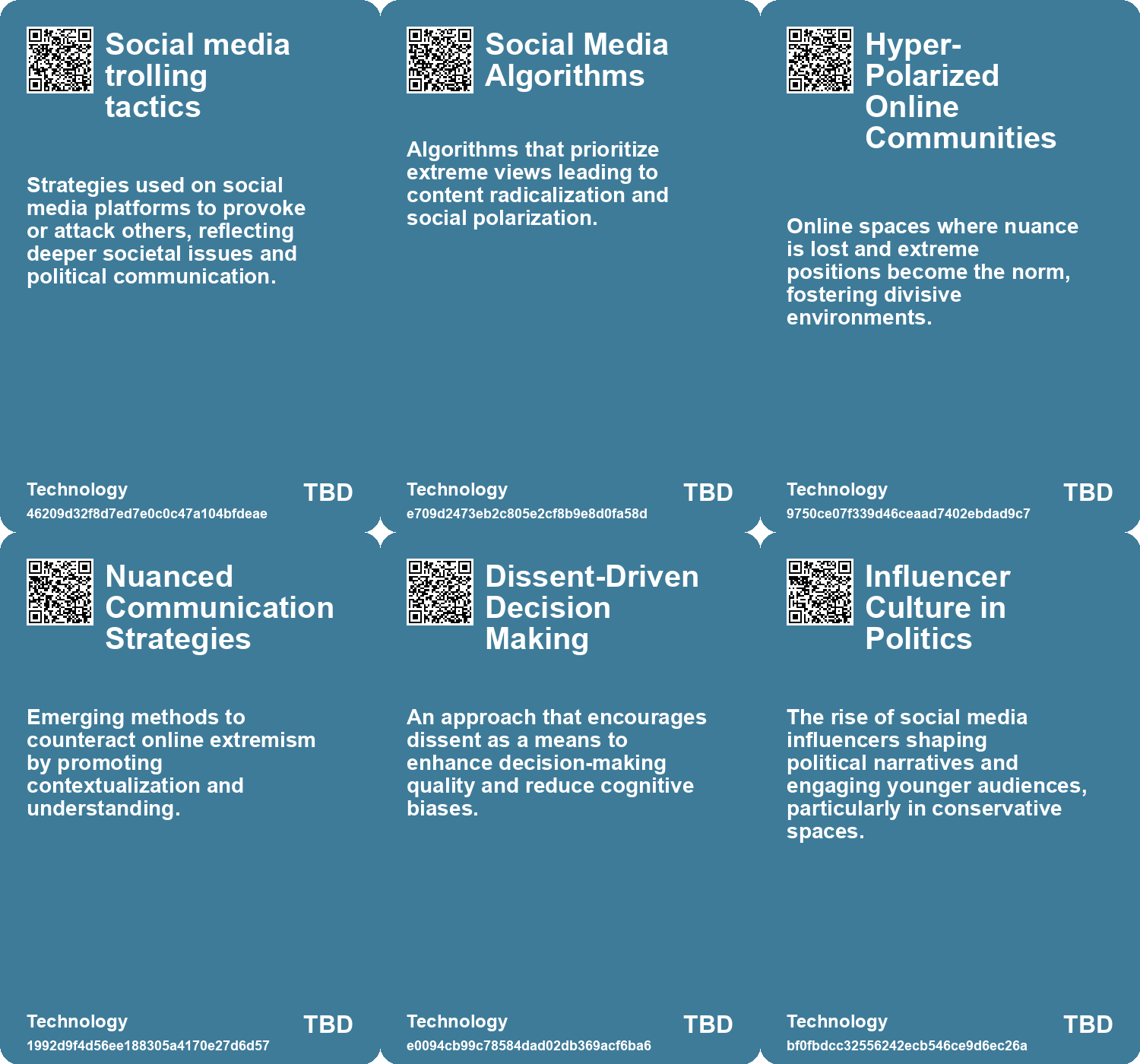
Technology
Links
- Study Reveals Shift in Political Bias of ChatGPT Towards the Right
- The Impact of Urban Design on Public Space Usage and Social Interaction
- Exploring the Rise of Violence and Radicalization on Social Media Platforms
- Zohran Mamdani’s Campaign: A Refreshing Approach to Politics Against Establishment Norms
- Understanding Populism: Its Rise, Characteristics, and Implications in Today’s Politics
- Exploring the Modern Entertainment Landscape and Its Societal Implications
- Finland’s Innovative Approach to Combating Fake News Through Education
- Transformative Changes from 2014 to Today: AI, Energy, and Nationalism
- The Backlash Against Lina Khan: A Fight for Consumer Protection and Antitrust Reform
- Exploring Attitudes Towards Climate Change and the Planetary Crisis Through the Polak Game
- Addressing Threats to Democracy: Strategies for Resilience Against Misinformation and Manipulation
- Exploring Strategic Principles for Leadership and Adaptability in Complex Systems
- Exploring Enshittification, Futures Thinking in Architecture, and the Decline of Urban Scenius
- The Decline of Political Maturity in America: A Call for Responsible Citizenship
- The Case for Corporate Neutrality: Lessons from Higher Education on Political Silence
- The Illusion of Online Activism in the Age of Trump: Embracing Real-World Action Instead
- The Unraveling of Progressive Politics: Economic Shifts and Growing Conflicts
- Global Experts’ Pessimistic Outlook for the Next Decade: Key Survey Findings
- Navigating Climate Change: The Need for Community Resilience and Social Trust
- The Impact of Supersharers on Vaccine Hesitancy and Fake News Spread on Social Media
- Navigating the Climate Crisis: The Importance of Community and Social Trust in Adapting to Change
- Youthful Conservatism: Celebrations and Shifts in Trump’s Second Inauguration
- The Vital Role of Dissent in Effective Decision-Making for Organizations
- Understanding Polarization: Healing Our Relationship with Technology and Embracing Diverse Perspectives