Futures
Topic: Populist Political Engagement
Summary
Populism and Political Dynamics
Populism is resurging globally, characterized by the common man’s rebellion against established elites. This phenomenon draws parallels with historical instances from the 1930s, highlighting factors like wealth gaps, nationalism, and confrontations with oppositional forces. As populist leaders gain traction, understanding these dynamics is essential for predicting future economic policies and international relations. In the U.S., figures like Zohran Mamdani exemplify a new wave of populism, engaging younger voters through authentic messaging and addressing real community issues. This shift raises questions about the adaptability of traditional political establishments.
Economic Challenges and Class Disparities
The progressive economy faces significant challenges as traditional industries thrive while tech and media companies struggle. Union militancy and widening class distinctions contribute to a growing divide, with the credentialed precariat—educated young individuals burdened by debt—feeling increasingly disenfranchised. The decline in marriage rates and apprehension towards parenthood among young Americans further complicates civic engagement and community involvement. These economic pressures highlight the need for political representation that addresses the concerns of a changing demographic landscape.
Democracy and Civic Responsibility
The current state of democracy is precarious, threatened by misinformation and the rise of private power that undermines democratic institutions. The decline of maturity in political discourse, particularly under the influence of figures like Donald Trump, has led to a culture of trolling and juvenile behavior among leaders. Responsible citizens are urged to model mature behavior and demand higher standards from public officials. The importance of social trust and community resilience is emphasized as essential for navigating the challenges posed by climate change and political polarization.
Nonviolent Resistance and Social Movements
The effectiveness of nonviolent protests is underscored by the “3.5% rule,” which suggests that when a critical mass of the population engages in peaceful demonstrations, political change becomes likely. Historical examples illustrate the power of unity and moral high ground in achieving goals. Grassroots movements in cities like New York and Los Angeles demonstrate the potential for real-life networks to address local issues, moving beyond the distractions of online engagement.
Foreign Influence and Election Integrity
U.S. intelligence officials have identified Russia as the most active foreign power attempting to influence American politics, particularly favoring Donald Trump in the upcoming election. While there is no evidence of direct interference in voting systems, the Kremlin’s comprehensive approach to shaping public opinion raises concerns. In contrast, China and Iran play more muted roles in this complex landscape of foreign influence, highlighting the ongoing challenges to electoral integrity.
Technological Impact and Cultural Shifts
The rapid advancement of technology, particularly artificial intelligence, is reshaping political polling and public engagement. Experts propose that AI simulations could replace traditional polling methods, despite concerns about potential misuse. The influence of technology extends to societal polarization, with calls for a cultural shift towards prioritizing attention and community over digital distractions. The need for a Talmudic approach, considering multiple perspectives, is suggested as a remedy for the societal sickness exacerbated by technology.
Community and Environmental Resilience
Innovative initiatives in U.S. cities aim to transform public spaces and foster civic engagement through the Reimagining the Civic Commons model. These projects emphasize collaboration, socioeconomic mixing, and environmental sustainability, addressing trends like loneliness and economic segregation. Building strong community ties is essential for adapting to climate-related challenges, underscoring the importance of collective action in navigating a warming world.
Seeds
| name | description | change | 10-year | driving-force | |
|---|---|---|---|---|---|
| 0 | Youth Political Shift | Younger voters increasingly supporting populist candidates over traditional party candidates. | Transition from voting for mainstream candidates to supporting outsiders who represent their interests more. | Future elections may be dominated by candidates prioritizing youth and affordability issues. | A younger generation disillusioned by traditional parties and seeking alignment with new ideologies. |
| 1 | Populist Momentum in Politics | Populism rising within mainstream parties, challenging traditional power structures. | Shift from established political ideologies to populist movements that advocate for the underprivileged. | Political landscapes could see more populist candidates emerging, reshaping party platforms and policies. | Growing economic precarity and disenfranchisement driving citizens to seek alternative political representation. |
| 2 | Rise of Populism in Czech Politics | Populist figures gaining traction in Czech elections, indicating a shift in political landscape. | Shift from a pro-Western coalition towards a more populist and potentially extremist government. | Possible normalization of extreme political views and alliances in Czech governance. | Growing disillusionment with traditional parties and increased demand for populist rhetoric. |
| 3 | Resurgence of Populism | Populism has surged in developed countries to its highest level since the 1930s. | From infrequent occurrences in developed countries to a significant political force. | Populism may reshape political landscapes, leading to more populist leaders and policies. | A growing discontent among the populace regarding wealth gaps and ineffective governance. |
| 4 | Populist Playbook | Historical analysis reveals a common template among past populist leaders. | Understanding of populism shifts from chaotic to a structured template for analysis. | Political analysts will use the populist template to predict future movements and leaders. | A desire for clarity in political trends and historical context to inform future predictions. |
| 5 | Conflict Management in Populism | Populism leads to increased conflict and disorder within countries. | From cooperative political environments to confrontational and exclusive dynamics. | Political systems may evolve to manage conflicts more effectively or become more authoritarian. | The need for stability and order in response to increasing political polarization. |
| 6 | Impact on Economic Policies | Populism is expected to influence economic policies more than traditional methods. | From reliance on classic monetary and fiscal policies to populist-driven economic strategies. | Future economies may prioritize populist policies like protectionism and nationalism. | Economic instability and public demand for immediate results from leadership. |
| 7 | Media Influence by Populists | Populist leaders often engage in controlling media narratives. | From independent media to populist-controlled narratives that reinforce their agendas. | Media landscapes may become more polarized, with fewer independent voices and more propaganda. | A need for populist leaders to consolidate power and support through media control. |
| 8 | Global Populism Trends | Increased international relations driven by populist confrontations. | From cooperative international relations to confrontational stances between nations. | Global politics may see a rise in nationalist policies and reduced collaboration. | Populist leaders’ need to unify domestic support through external conflicts. |
| 9 | Growing Distrust in Institutions | Workers exhibit increasing distrust towards institutions, paralleling political electoral abstention. | Shift from trust and engagement in institutions to a sense of disillusionment and disengagement. | Potential rise in alternative governance models or community-led initiatives in response to institutional failures. | Continuous failure of traditional institutions to address people’s needs and concerns. |
Concerns
| name | description | |
|---|---|---|
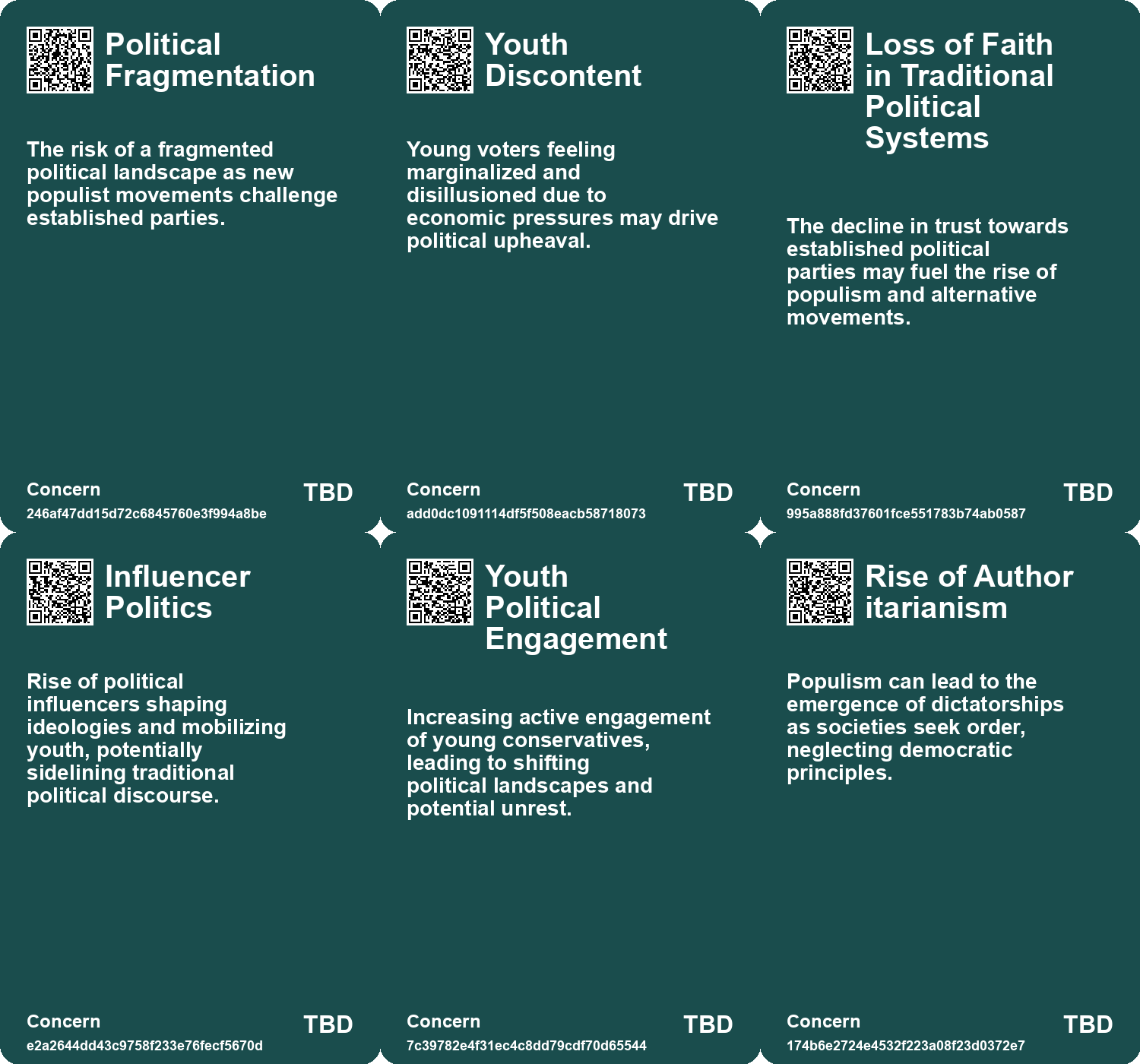
| 0 | Political Fragmentation | The risk of a fragmented political landscape as new populist movements challenge established parties. |
| 1 | Youth Discontent | Young voters feeling marginalized and disillusioned due to economic pressures may drive political upheaval. |
| 2 | Loss of Faith in Traditional Political Systems | The decline in trust towards established political parties may fuel the rise of populism and alternative movements. |
| 3 | Influencer Politics | Rise of political influencers shaping ideologies and mobilizing youth, potentially sidelining traditional political discourse. |
| 4 | Youth Political Engagement | Increasing active engagement of young conservatives, leading to shifting political landscapes and potential unrest. |
| 5 | Rise of Authoritarianism | Populism can lead to the emergence of dictatorships as societies seek order, neglecting democratic principles. |
| 6 | Increased Social Conflict | The confrontational nature of populist leaders can escalate tensions between different social and economic groups, leading to violence. |
| 7 | Economic Instability Caused by Populist Policies | Populist economic policies such as protectionism may lead to global economic instability and trade conflicts. |
| 8 | Manipulation of Media | Populist regimes may seek to control or manipulate media, limiting free speech and the dissemination of information. |
| 9 | Xenophobia and Cultural Isolation | Populism often capitalizes on xenophobic sentiments, increasing cultural tensions and isolation from global perspectives. |
Cards
Concerns
Behaviors
Issue
Technology
Links
- Innovative Approaches to Public Space Transformation in U.S. Cities
- The Interplay of Democracy, Work, and Economic Justice in Modern Society
- Harvard Scholars Advocate for AI in Political Polling Amid Declining Human Engagement
- The Impact of Declining Marriage Rates on American Society and Community Involvement
- Zohran Mamdani’s Campaign: A Refreshing Approach to Politics Against Establishment Norms
- Russell Vought’s Ideological War Against Government and the Rise of the Addiction Economy
- Understanding Populism: Its Rise, Characteristics, and Implications in Today’s Politics
- The Freedom Summit: A Rallying Cry for Anti-Vaccine Sentiments and Medical Distrust
- Transformative Changes from 2014 to Today: AI, Energy, and Nationalism
- Zohran Mamdani’s Victory: A Reflection of Rising Credentialed Precariat and Political Change in NYC
- Ziklag’s $12 Million Strategy to Influence 2024 Election Through Voter Mobilization and Purging
- Czech Elections: Populist Billionaire Babis Faces Challenges with Extreme Political Allies
- Exploring Kate Soper’s Vision for Sustainable Living in ‘Post-Growth Living’
- Exploring Six Narratives on Trump’s 2024 Election Victory and Quincy Jones’ Creative Philosophy
- Addressing Threats to Democracy: Strategies for Resilience Against Misinformation and Manipulation
- The Decline of Political Maturity in America: A Call for Responsible Citizenship
- The UK’s Declining Geopolitical Relevance and Elite Inaction: A Historical Perspective
- The Illusion of Online Activism in the Age of Trump: Embracing Real-World Action Instead
- The Unraveling of Progressive Politics: Economic Shifts and Growing Conflicts
- Navigating Climate Change: The Need for Community Resilience and Social Trust
- Navigating the Climate Crisis: The Importance of Community and Social Trust in Adapting to Change
- Youthful Conservatism: Celebrations and Shifts in Trump’s Second Inauguration
- U.S. Intel: Russia Continues to Favor Trump in Election Influence Efforts
- Understanding Polarization: Healing Our Relationship with Technology and Embracing Diverse Perspectives