Futures
Topic: Cultural Homogenization
Summary
The current cultural landscape is marked by a growing oligopoly in pop culture, where a few major players dominate the market. This trend is evident across various media, including movies, music, and video games, leading to a proliferation of remakes and sequels at the expense of original content. The consolidation of studios and labels stifles creativity and limits the diversity of available content, although there remains potential for unique voices to emerge if consumers actively seek them out.
Fashion and identity among Gen Z reflect a shift from chaotic individuality to a polished uniformity shaped by social media algorithms. This change raises questions about the loss of rebellion and whether conformity represents a new form of resistance. Economic and technological forces play a significant role in shaping how today’s youth express themselves through fashion.
The rise of artificial intelligence (AI) generation tools has led to concerns about the homogenization of content, a phenomenon termed “The Great Same-ning.” While AI can enhance individual creativity, it risks diminishing collective novelty. Studies indicate that the outputs of these tools often lack diversity, emphasizing the need for thoughtful use to foster distinctiveness.
As democratic institutions decline and autocratic governance rises, significant societal shifts are anticipated by 2040. Emerging cultural movements, such as Decorp Culture, challenge traditional corporate values, while a focus on Safety Culture prioritizes stability. Economic models are expected to evolve towards stagflation, prompting new consumer behaviors that brands must adapt to in order to remain relevant.
The decline of social media quality, termed “enshittification,” is attributed to a lack of competition and regulation. This decline underscores the importance of user connections and calls for a reimagining of architecture to benefit society. The stagnation of urban artistic communities further highlights the challenges facing innovative cultural movements.
The impact of technology on society is profound, with polarization and addiction becoming prevalent issues. The author advocates for a cultural shift towards embracing multiple perspectives, drawing on Talmudic principles to counteract the negative effects of digital technologies. This approach emphasizes the importance of attention over availability and suggests that accepting limited choices can lead to greater freedom and happiness.
Hyper-personalization, driven by technology and social media, reflects a shift from communal to individualistic culture. The popularity of trends like Bean Soup on TikTok illustrates this phenomenon, raising questions about the implications of hyper-personalization across various industries, including healthcare and education. Meanwhile, the emergence of fleeting fads, particularly from non-Western origins, highlights a cultural stagnation influenced by social media.
The rise of cozy lit, a new literary genre, offers comfort amidst the complexities of modern life. However, it risks commodifying gentleness and lacks the reflective depth of its Eastern origins. This genre mirrors the passive consumption of digital content, providing momentary pleasure without substantive engagement.
The fusion of hip-hop and traditional dance forms, as seen in Usha Jey’s work, showcases the blending of cultures and the global appeal of hip-hop as a voice for youth identity. This cultural exchange emphasizes the importance of adaptability in organizational culture, drawing lessons from historical events like the Battle of Crecy.
The fragmentation of culture and software due to AI democratization is evident in the rise of platforms that enable creativity. However, this trend also leads to further fragmentation of popular culture, as traditional media distribution is disrupted. The article highlights the need for companies to focus on building tools and networks that support this new wave of content creation.
The concept of “greenhindering” reveals how socialization agents perpetuate unsustainable practices, contrasting with the more scrutinized greenwashing. This highlights the challenge of fostering sustainability in a throwaway culture, calling for accountability from media and influencers.
The critique of ‘Millennial branding’ in consumer packaging reflects a lack of originality and connection to product quality. The tension between nostalgia and contemporary design trends raises questions about the future of branding in consumer culture.
The symbolic economy emphasizes consumption tied to identity performance, where purchases signal personal values. As trust in traditional institutions declines, brands increasingly assume roles as moral authorities, shaping identities and communities.
The phenomenon of abandonment in rural areas, particularly in Bulgaria, illustrates the demographic shifts affecting global populations. The relationship between human absence and environmental change raises critical questions about the future of abandoned lands and their ecological outcomes.
The ongoing reshuffling of land ownership highlights the complexities of land tenure and its societal implications. As climate change and population dynamics shift, innovative land reform is necessary to promote social equity and address future challenges.
Contemporary homes are evolving, with changes in space organization and quality influenced by the pandemic. The shrinking size of new apartments and the changing perception of personal spaces reflect broader societal challenges that require collective solutions.
Seeds
| name | description | change | 10-year | driving-force | |
|---|---|---|---|---|---|
| 0 | Cultural Co-optation of Asian Literature | Western markets increasingly consume and assimilate Japanese and Korean literary styles. | Gradual transition from authentic storytelling to Westernized interpretations of Eastern narratives. | Asian literary themes may reshape Western literary canon and reader preferences. | Western obsession with Asian culture, driven by social media and tourism. |
| 1 | Cultural Monoculture | A globally connected culture is leading to a uniformity in consumer behavior and identity signaling. | Transition from local cultural identities to global monocultural consumption patterns. | Global brands will become the primary identity anchors for individuals in diverse cultures. | The accessibility of information and products worldwide diminishes regional distinctions. |
| 2 | Shift in Cultural Production Base | Cultural production is moving away from the U.S. to online-first trend-driven cultures. | A transition from U.S.-centric cultural production to global, primarily online-driven production. | Expect to see a diverse range of cultural outputs originating from non-Western countries. | The rise of social media platforms promoting rapid trend cycles and global connectivity. |
| 3 | Emerging Middle Class Culture | New middle classes in non-Western regions are forming identities based on trendiness. | A shift from stable cultural identities to fluid, trend-based self-presentation in emerging markets. | Expect a generation of consumers whose identities are built on a mosaic of global fads. | Economic growth and increased internet access in developing regions enabling trend participation. |
| 4 | Cultural Fragmentation | The decline in shared cultural references amidst rising digital content. | Shifting from a shared mainstream culture to a highly diversified culture. | Cultural experiences will increasingly cater to niche interests over mainstream trends. | The internet and AI will continue to allow diverse content creation and distribution. |
| 5 | Spirited Tech | Blending of technology with alternative spiritualities influencing culture and personal identity. | Transition from purely functional technology to more holistic and spiritual engagements with technological advancements. | By 2034, personal identities may increasingly intertwine with technological and spiritual expressions in daily life. | The search for meaning in an advanced tech society prompts exploration of new identities and relationships. |
| 6 | Homogenization of Urban Aesthetics | Cities across the U.S. exhibit similar architectural and cultural aesthetics. | Shift from unique local identities to a standardized urban experience. | In a decade, urban areas may look increasingly similar, diminishing local charm. | Globalization and social media influence the design and culture of local establishments. |
| 7 | Gentrification and Return Migration | Young adults return to hometowns, bringing urban aesthetics and culture with them. | Movement from urban centers back to smaller towns, merging cultures. | Small towns may become cultural hubs, blending urban and rural lifestyles. | Cost of living and desire for community drive return migration trends. |
| 8 | The Great Same-ning | A term describing AI tools’ tendency to produce homogenous content. | Shift from diverse, unique content to uniform outputs due to AI training. | In 10 years, creative outputs may all appear similar, lacking diversity and uniqueness. | The increasing reliance on AI tools for content generation leads to averaged outputs. |
| 9 | Opportunities in Distinctiveness | Homogeneity creates a market for unique and distinct outputs. | From a saturated market of sameness to a growing demand for distinct creativity. | The future may see a premium placed on unique and diverse outputs in all fields. | The need for differentiation will drive demand for unique creative expressions. |
Concerns
| name | description | |
|---|---|---|
| 0 | Cultural Co-optation | The appropriation of Eastern literary traditions and aesthetics by the West, potentially diluting their original significance and meaning. |
| 1 | Cultural Monoculture | The rise of a globally uniform culture reduces local identities and unique expressions, leading to potential cultural homogenization. |
| 2 | Loss of Cultural Identity | The rise of fads may erode authentic cultural identities as people prioritize trendiness over substance. |
| 3 | Global Cultural Imbalance | The shift of cultural production towards non-Western countries may challenge American cultural dominance, leading to societal shifts. |
| 4 | Brand Identity Crisis | The difficulty brands face in maintaining a unique identity amidst trends that push for homogenized aesthetics. |
| 5 | Cultural Homogenization | Cities are increasingly adopting similar aesthetics and cultural vibes, leading to a loss of unique local identities. |
| 6 | Algorithmic Influence on Identity | The pervasive influence of algorithms on fashion choices may dilute individuality, leading to a homogenized culture. |
| 7 | Cultural Homogeneity | The increasing dominance of a few franchises leads to cultural sameness, stunting creativity and diversity in media. |
| 8 | Digital Influence on Cultural Heritage | The popularity of online platforms may overshadow traditional forms of dance and cultural expression, leading to homogenization. |
| 9 | Reinforcement of Common Trends | Popular AI-generated outputs could overshadow rare or distinct options, leading to a homogenized cultural landscape. |
Cards
Concerns
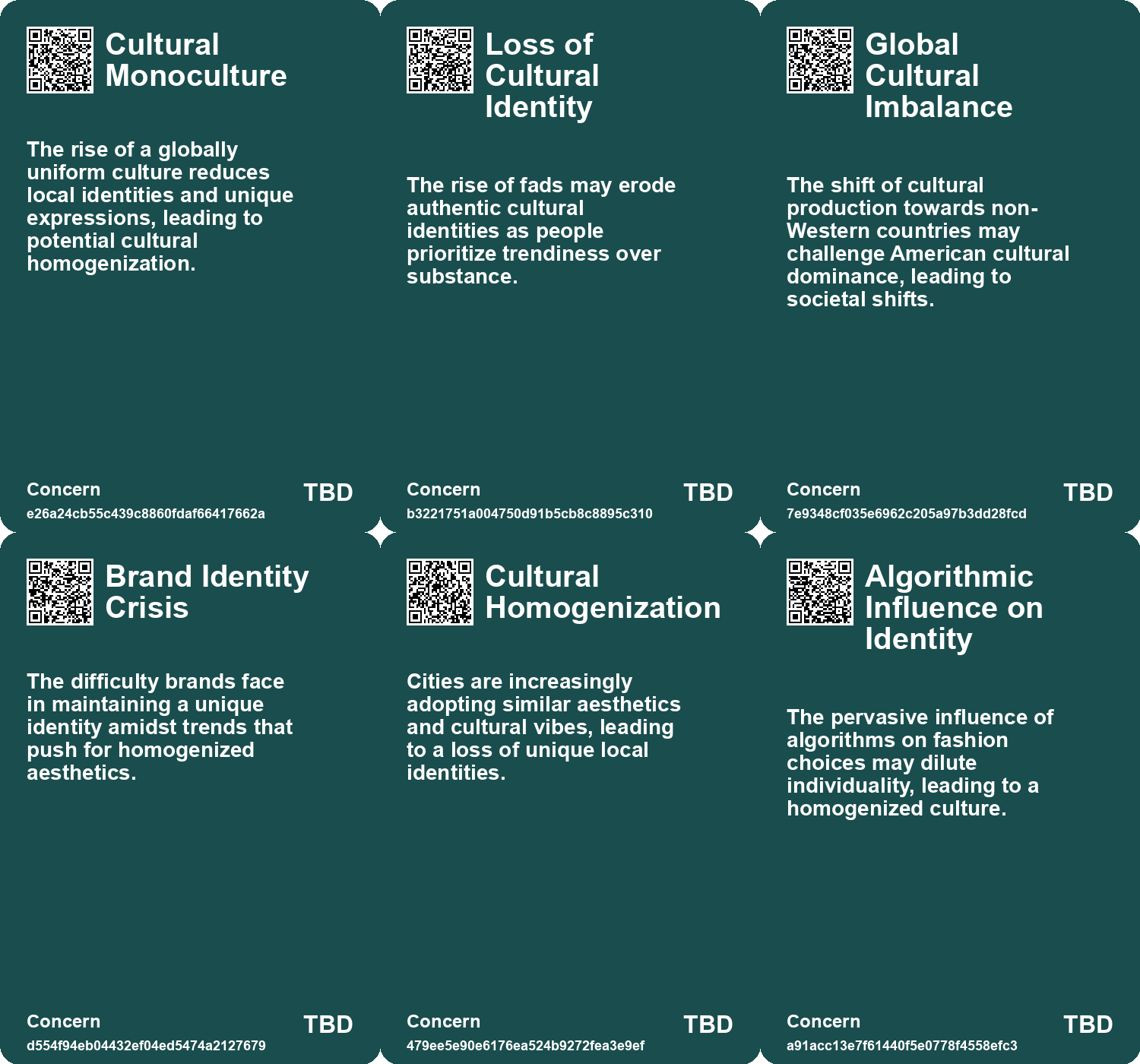
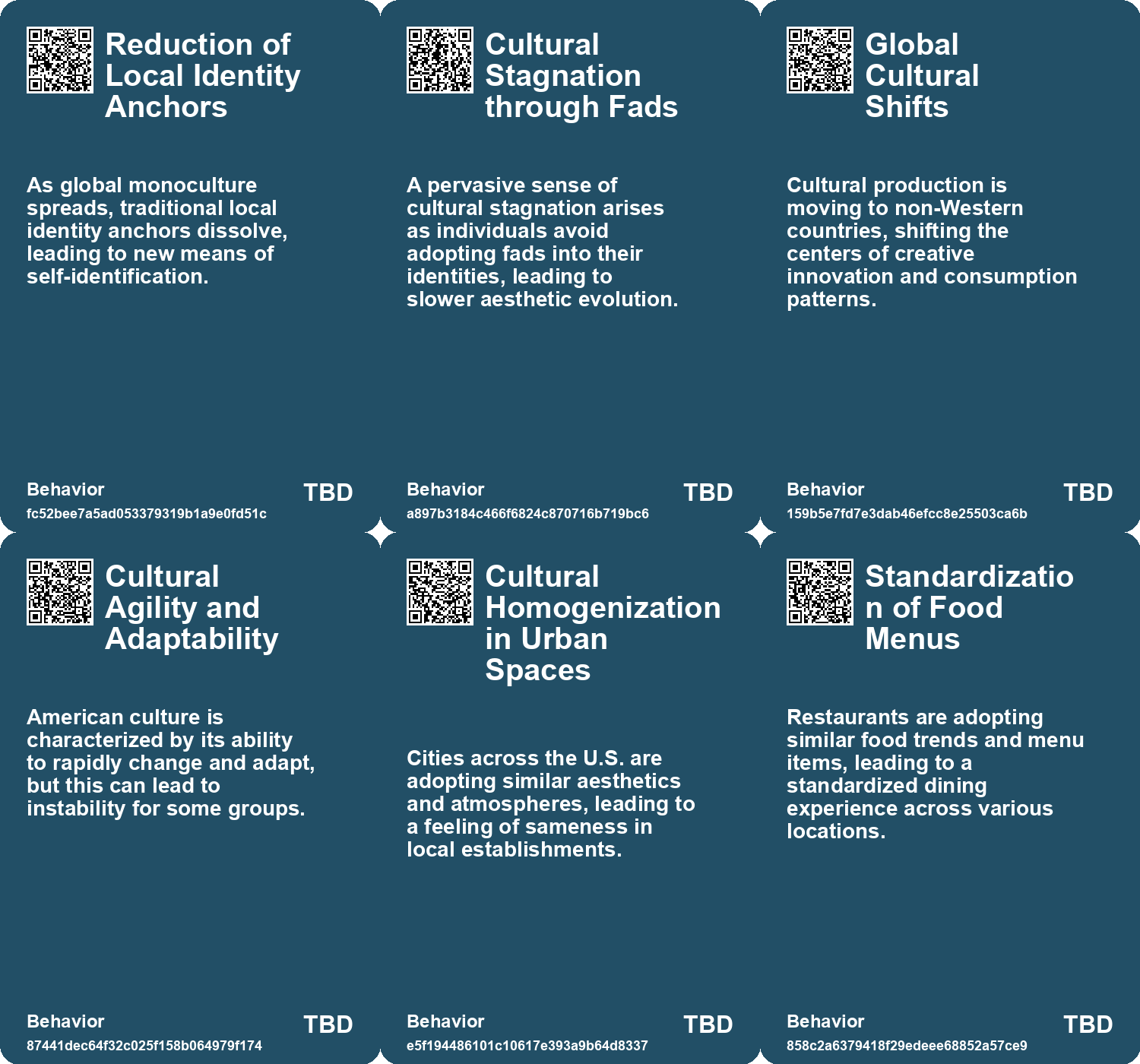
Behaviors
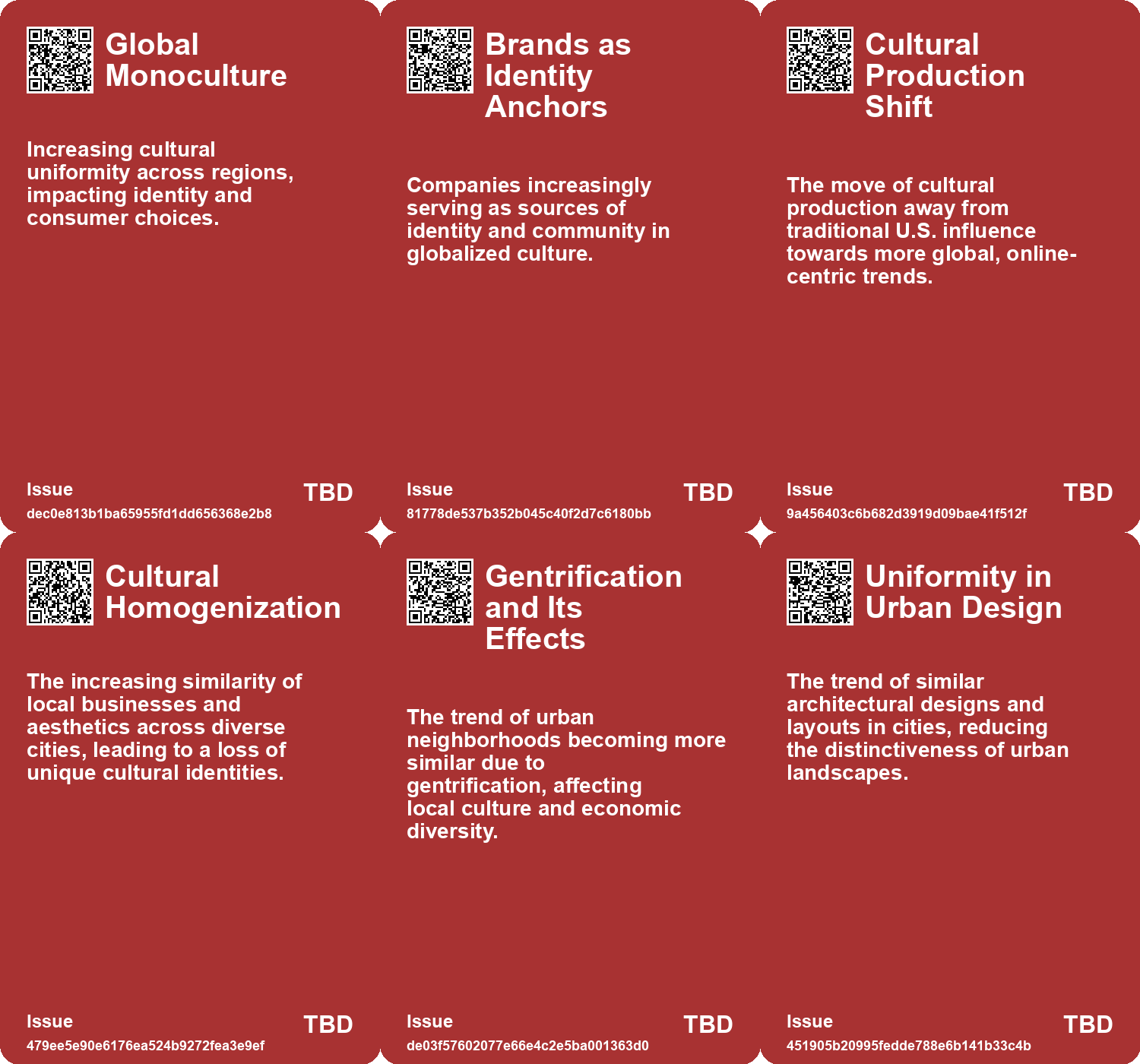
Issue
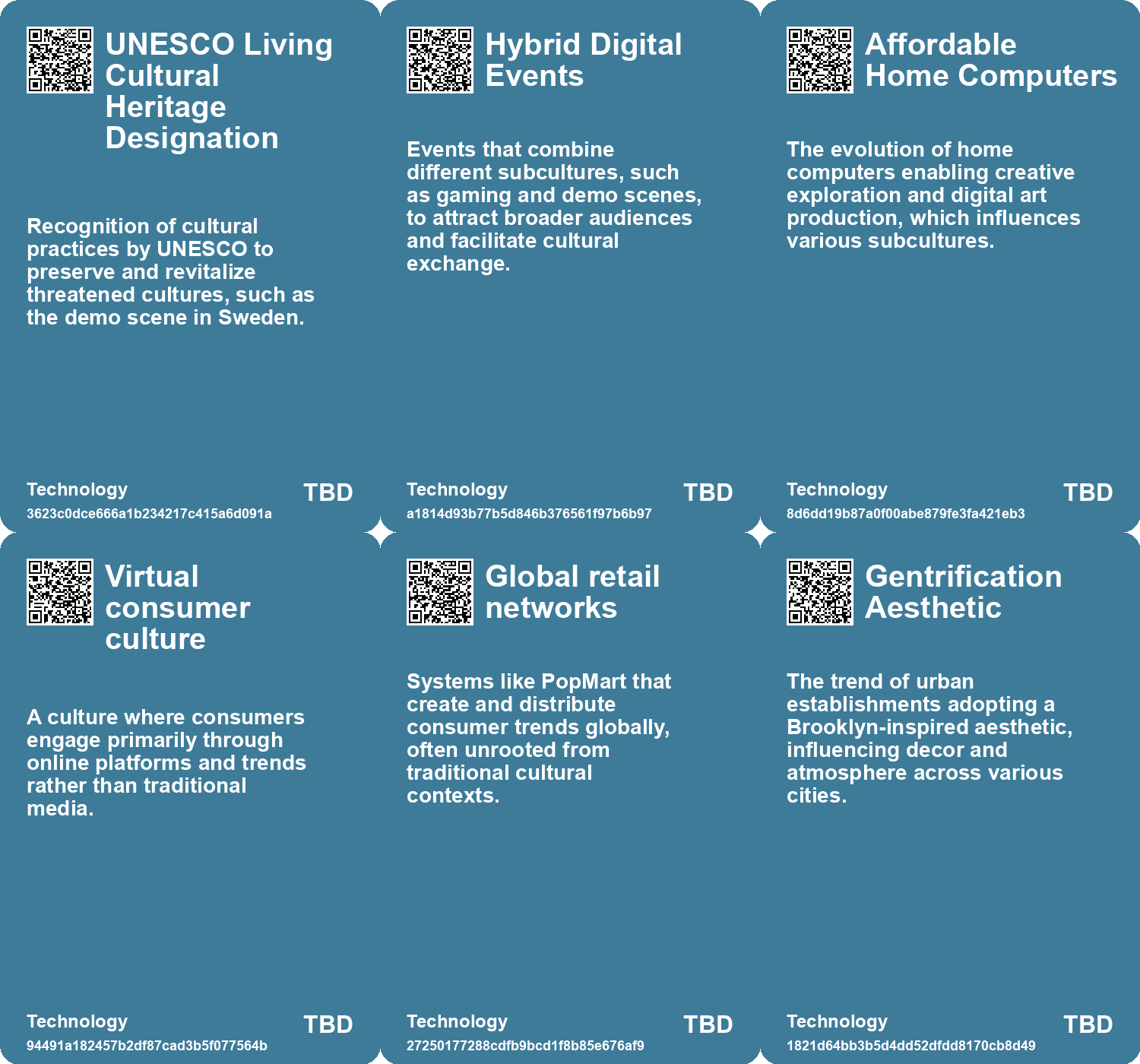
Technology
Links
- The Economic Consequences of Declining Birth Rates and Aging Populations
- Understanding ‘Failure to Launch’: The Cultural and Economic Struggles of Young American Men
- Exploring the Homogenization of Urban Culture Through Coffee Shops and Bars Across America
- Exploring the Modern Entertainment Landscape and Its Societal Implications
- Understanding Greenhindering: A Greater Challenge Than Greenwashing for Sustainability
- Exploring the Cultural and Economic Impact of Fads Like Labubu in the 21st Century
- The Rise and Implications of Cozy Lit in the Age of Digital Distraction
- Exploring the Consequences of Abandonment in Rural Bulgaria and Nature’s Response
- From Household Gods to Machine Gods: The Evolution of Human Dependence on Idols and AI
- Navigating Gen Z Fashion: From Individuality to Algorithmic Uniformity
- Exploring the Risks of Homogeneity in AI Generated Content and Its Impact on Creativity
- The Rise of Cultural Oligopoly: A Call for Diversity in Media
- Exploring the Impact of Hyper-Personalization in the Age of AI and Individualism
- Exploring Urban Change and Psychological Responses in Austin’s Transformation
- Bumblebees Exhibit Cultural Behavior: New Insights into Insect Learning and Social Behavior
- Les Transformations Contemporaines de l’Habitat et le Rôle des Générations Futures
- Exploring Enshittification, Futures Thinking in Architecture, and the Decline of Urban Scenius
- The Rise of the Symbolic Economy: Identity Through Consumption in a Globalized World
- Nostalgia for Simplicity: The Burden of Infinite Choice in Modern Life
- The Psychological Impact of Algorithmic Profiling and Surveillance on Self-Identity in the Digital Age
- The Decline of Political Maturity in America: A Call for Responsible Citizenship
- Exploring Cultural Fusion in Dance and Lessons from the Battle of Crecy
- Critique of Millennial Branding in Consumer Packaging and Its Impact
- AI’s Role in Fragmenting Culture and Software: A New Era of Creation
- Exploring the Historical and Future Transformations of Land Ownership Worldwide
- Future Trends Post-2024: Declining Democracies and Emerging Cultural Shifts
- The Demo Scene: A Cultural Legacy Facing Decline and Change
- Understanding Polarization: Healing Our Relationship with Technology and Embracing Diverse Perspectives