Futures
Topic: Information Saturation
Summary
The digital age has ushered in an era of information overload, affecting both individuals and organizations. Many people experience information fatigue, struggling to navigate the constant stream of news and data from various sources. This phenomenon has implications for mental health and democratic engagement, as individuals grapple with how to consume information responsibly. The need for curated content and structured knowledge management is increasingly recognized, as organizations seek to harness data effectively while mitigating the risks of misinformation.
In the realm of technology, vulnerabilities in satellite communications have raised alarms about data security. A recent study revealed that many satellite signals remain unencrypted, exposing sensitive information to potential eavesdroppers. This highlights the urgent need for enhanced encryption measures to protect personal and organizational data from unauthorized access.
The concept of the holographic theory suggests that deep study in one area can yield insights into broader realities. This approach applies to various fields, from literature to programming, where understanding context and interconnectedness enriches knowledge. Such depth of study is essential in an age where superficial engagement often prevails.
The impact of artificial intelligence on information dissemination is profound. AI has transformed content creation, reducing the cost of producing information to nearly zero. However, this has led to attention scarcity, as users are bombarded with content. The role of influencers and aggregators in managing this abundance is critical, as trust in information sources becomes increasingly scarce.
Digital literacy is emerging as a vital skill in combating misinformation. Finland’s innovative approach to integrating fact-checking and digital literacy into its education system serves as a model for other countries. By teaching students to critically evaluate information, Finland aims to foster a generation capable of navigating the complexities of the digital landscape.
The challenges of data preservation in the digital age are significant. Unlike physical artifacts, digital files face obsolescence due to changing technologies. The risk of a “Digital Dark Age” looms, emphasizing the need for sustainable practices in data management. Collective efforts across sectors are essential to ensure that valuable information is preserved for future generations.
Finally, the evolution of communication tools, such as PowerPoint and digital whiteboards, raises questions about their effectiveness. While these tools are designed to enhance collaboration, they can sometimes prioritize form over substance, leading to fragmented ideas. The shift towards digital communication during the pandemic has further complicated this landscape, as the balance between clarity and creativity remains a challenge.
As society navigates these overlapping themes, the interplay between technology, information management, and education will shape the future of communication and knowledge.
Seeds
| name | description | change | 10-year | driving-force | |
|---|---|---|---|---|---|
| 0 | Holographic Learning Principle | Deep study of one subject reveals insights about the entire reality. | Shift from superficial learning to deep, interconnected understanding of knowledge. | Education systems may adopt more interdisciplinary approaches, emphasizing deep study of singular subjects. | Growing recognition of interconnectedness in knowledge and the need for holistic understanding. |
| 1 | Information Post-Scarcity | AI reduces content production costs to zero, leading to a surplus of information. | Shifting from scarcity in content production to a state of abundance and overproduction. | A future where content is produced in excess, creating new dynamics in consumption and attention. | Advancements in AI technology enabling mass content generation and transformation. |
| 2 | Attention Economy | Amidst information abundance, the attention of users becomes increasingly scarce. | Transitioning from content scarcity to a critical shortage of user attention. | New strategies and tools will emerge to capture and retain user attention in a saturated market. | The overwhelming influx of information necessitating efficient attention allocation. |
| 3 | Emergence of New Aggregators | The superabundance of content may lead to rapid creation and collapse of aggregators. | Transitioning from stable, entrenched aggregators to a fast-paced innovation cycle. | A marketplace characterized by transient aggregators rapidly emerging and failing, increasing competition. | The fluidity of content availability and the necessity for aggregation in an oversaturated market. |
| 4 | Holographic Learning Principle | Deep study of one subject reveals insights about the entire reality. | Shift from superficial learning to deep, interconnected understanding of knowledge. | Education systems may adopt more interdisciplinary approaches, emphasizing deep study of singular subjects. | Growing recognition of interconnectedness in knowledge and the need for holistic understanding. |
| 5 | Midinformation Concept | The emergence of ‘midinformation’ characterized by ambiguity and incomplete data. | From clear, concise information to a reality where ambiguity is increasingly common in knowledge acquisition. | In 10 years, systems may evolve to better handle complex and ambiguous information rather than just providing certainty. | The complex nature of knowledge and the limitations of current information systems to address it. |
| 6 | Digital Information Systems Opacity | Concerns about the lack of transparency in modern information retrieval systems. | From clear, accessible information to systems that are often opaque and difficult to understand. | In 10 years, there may be a push for transparency and accountability in information retrieval processes, enhancing user trust. | Growing awareness and concern over data privacy and the complexities of algorithms. |
| 7 | Cognitive Overload from Information | The volume of information produced is causing cognitive overload for individuals. | Shift from manageable information processing to overwhelming amounts of data. | In 10 years, cognitive overload may lead to burnout and reduced productivity. | The ease of generating content leads to an exponential increase in information available. |
| 8 | Critique of Infinite Choices | Concern about the overwhelming nature of endless choices in media and consumer goods. | From abundance of choices leading to dissatisfaction to a focus on quality and depth. | A cultural shift towards valuing limited options that enhance satisfaction and creativity. | Fatigue from constant curation and the search for meaningful experiences. |
| 9 | Rise of Misinformation Awareness | Increased awareness of misinformation spread through digital platforms. | Growing recognition of misinformation as a significant societal issue. | Stronger emphasis on digital literacy and critical evaluation of information sources. | The overwhelming volume of information available online necessitating discernment. |
Concerns
| name | description | |
|---|---|---|
| 0 | Propagation of Misinformation | The prevalence of lies and absurdities online diminishes the media’s ability to effectively filter information, leading to widespread misinformation. |
| 1 | Information Overload | The overwhelming amount of information available leads to desensitization and devaluation of local community efforts. |
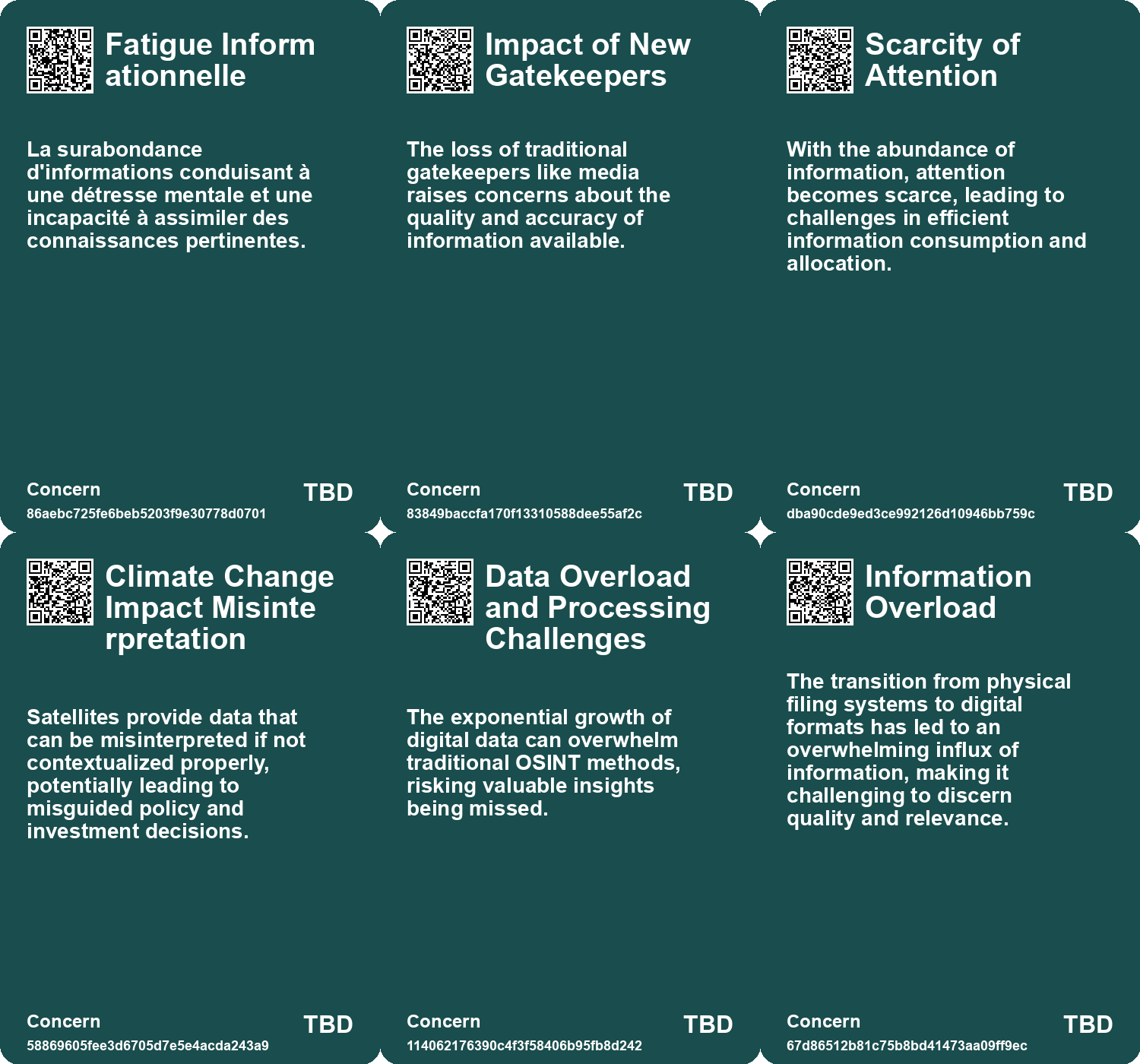
| 2 | Fatigue Informationnelle | La surabondance d’informations conduisant à une détresse mentale et une incapacité à assimiler des connaissances pertinentes. |
| 3 | Impact of New Gatekeepers | The loss of traditional gatekeepers like media raises concerns about the quality and accuracy of information available. |
| 4 | Scarcity of Attention | With the abundance of information, attention becomes scarce, leading to challenges in efficient information consumption and allocation. |
| 5 | Climate Change Impact Misinterpretation | Satellites provide data that can be misinterpreted if not contextualized properly, potentially leading to misguided policy and investment decisions. |
| 6 | Data Overload and Processing Challenges | The exponential growth of digital data can overwhelm traditional OSINT methods, risking valuable insights being missed. |
| 7 | Dependence on Curation | Over-reliance on curated knowledge bases may hinder adaptability and the exploration of diverse information sources. |
| 8 | Overemphasis on Form vs. Content | The trend prioritizes aesthetic and format in communication over substantial content, undermining the efficacy of information exchange. |
| 9 | Overwhelm from Infinite Choices | The abundance of choice in media and entertainment leads to decision fatigue and dissatisfaction with experiences. |
Cards
Concerns
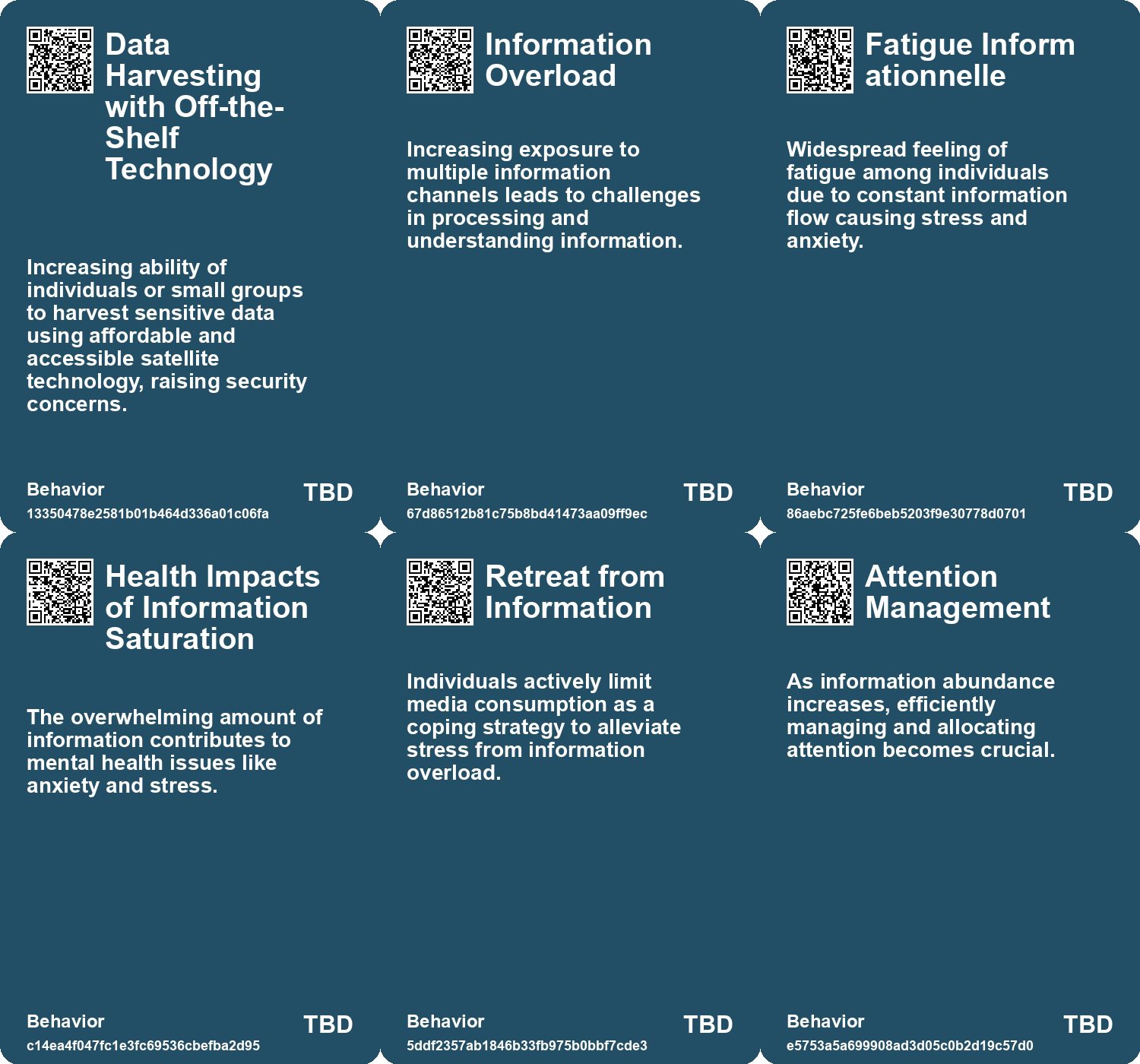
Behaviors
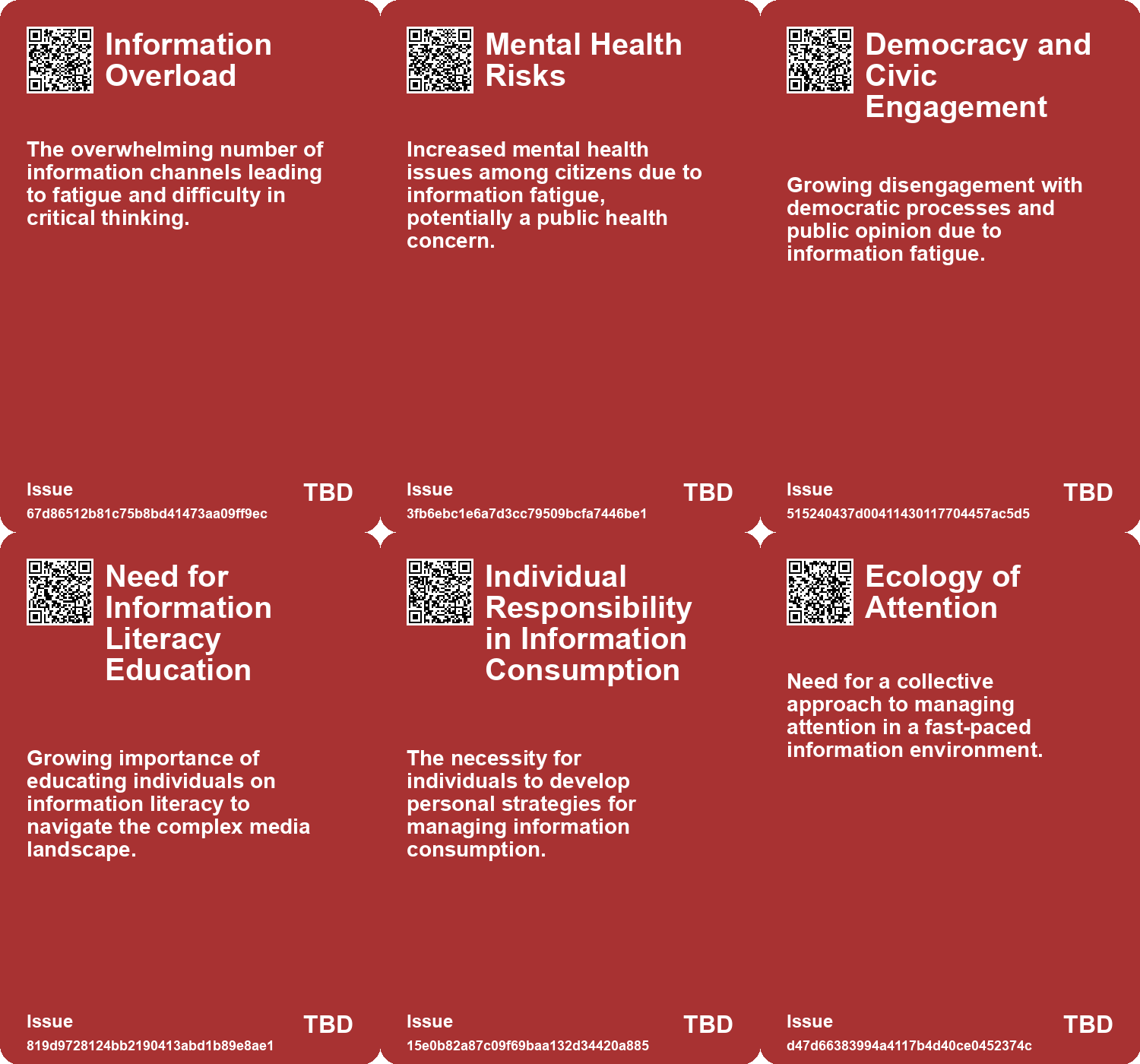
Issue
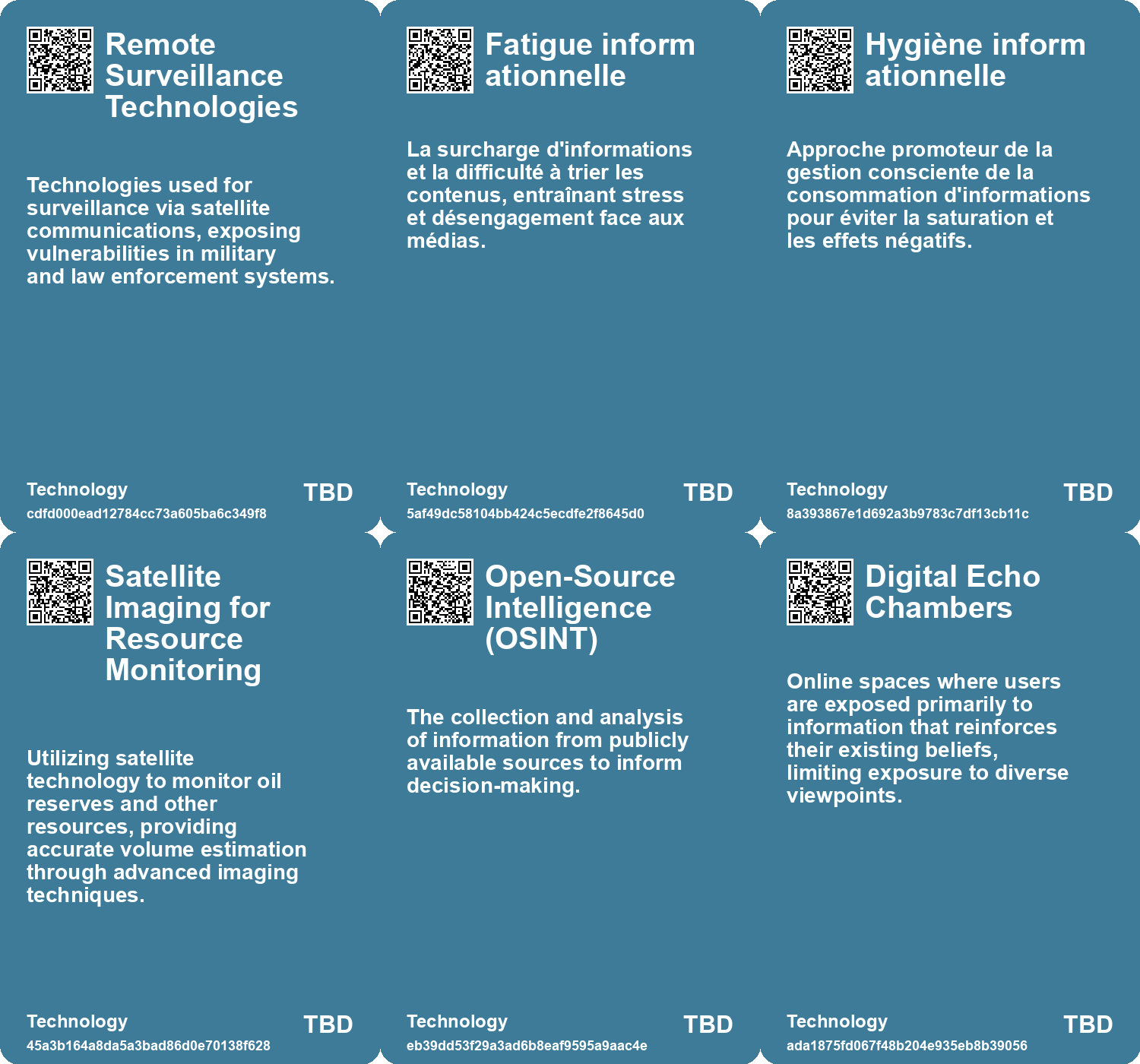
Technology
Links
- Navigating Information Overload: The Role of Knowledge Management and AI in Decision-Making
- Exploring the Impact of AI and LLMs on Content Creation and Information Scarcity
- Transforming Open-Source Intelligence: The Role of AI and Machine Learning in Modern Data Analysis
- Harnessing Satellite Data and AI for Enhanced Economic and Environmental Insights
- The Legacy of the Filing Cabinet: From 19th Century Innovation to Modern Information Management
- Exploring the Modern Entertainment Landscape and Its Societal Implications
- Richard Feynman’s Insight on Essential Knowledge for Future Generations
- Finland’s Innovative Approach to Combating Fake News Through Education
- Preserving Our Digital Future: The Challenge of Avoiding a Digital Dark Age
- Exploring the Holographic Theory of Learning and Its Implications for Understanding the World
- Google’s Transition to Remote Work and the Evolution of Information Security
- The Impact of the Internet and AI on Human Cognition and Productivity
- The Shift from SEO to AI: Enhancing User Experience and Information Retrieval
- Exploring Enshittification, Futures Thinking in Architecture, and the Decline of Urban Scenius
- Nostalgia for Simplicity: The Burden of Infinite Choice in Modern Life
- The Illusion of Online Activism in the Age of Trump: Embracing Real-World Action Instead
- Exploring the Ordinary Origins of Surveillance: Insights from Hochman and González’s New Books
- Exploring Grade Inflation and Compression at Harvard: Challenges to Academic Risk-Taking
- Exploring the Holographic Theory of Learning and Its Implications for Understanding the World
- Exploration de la Fatigue Informationnelle en France : Enquête et Impacts
- Understanding Polarization: Healing Our Relationship with Technology and Embracing Diverse Perspectives
- The Limitations of Digital Whiteboards in Effective Communication
- New Study Reveals Alarming Vulnerabilities in Satellite Communications Security