Futures
Topic: Loss of Human Connection
Summary
The increasing reliance on technology is reshaping human interaction and emotional well-being. Many experts express concern that innovations designed to enhance convenience often lead to reduced face-to-face communication. This trend is evident in the rise of online shopping, AI chatbots, and automated services, which, while efficient, may diminish empathy and understanding among individuals. Sociologist Sherry Turkle warns that the preference for digital interactions over genuine human connections can exacerbate feelings of loneliness.
The U.S. Surgeon General’s report highlights a public health crisis of loneliness, with a significant portion of Americans feeling isolated. This crisis is particularly pronounced among younger generations, who are increasingly disconnected despite being digitally connected. The report calls for fostering meaningful relationships and suggests that technology companies should develop apps focused on social health metrics.
In a poignant example of technology’s emotional impact, a Korean documentary team created a virtual reality experience allowing a grieving mother to interact with a digital version of her deceased daughter. While this technology offers therapeutic benefits, it raises ethical questions about addiction and the potential for individuals to remain in a virtual world rather than processing grief in a healthy manner.
The decline of critical thinking skills in an AI-dominated era is another pressing concern. As students increasingly rely on AI for writing and problem-solving, educators warn of a decline in literacy and cognitive abilities. This trend threatens deep thinking and creativity, prompting calls for educational reforms that prioritize critical engagement over technological dependency.
The importance of human interaction is echoed in the reflections of Kurt Vonnegut, who emphasizes the value of simple, everyday exchanges. He argues that modern conveniences have eroded casual social interactions, which are essential for a fulfilling life. This sentiment resonates with the notion that relational labor—presence, commitment, and care—remains vital in an automated world.
The emergence of social-emotional AI in education and mental health raises ethical concerns about inequality in access to emotional support. While affluent individuals may benefit from personalized human services, those in less fortunate circumstances often rely on AI, leading to a depersonalization crisis. Balancing AI integration with human interaction is crucial to ensure equitable access to care.
The commodification of social issues and the transactional nature of modern life further complicate the search for authentic connections. Many individuals outsource their emotional stability and confidence, leading to dissatisfaction and a sense of emptiness. True fulfillment, it is argued, cannot be bought or outsourced but must be sought from within.
As AI continues to evolve, its impact on the labor market and human creativity remains a topic of debate. While some predict job displacement due to automation, others emphasize the potential for new professions that prioritize human connection and creativity. The challenge lies in preparing the workforce for these changes and ensuring that technology enhances rather than diminishes our cognitive and emotional capacities.
Seeds
| name | description | change | 10-year | driving-force | |
|---|---|---|---|---|---|
| 0 | Correlated Loneliness with Chatbot Use | Heavy usage of chatbots linked to feelings of loneliness and emotional dependence. | Shift from social media impact on mental health to chatbot effects. | Loneliness may increase as individuals rely more on AI companions instead of human interactions. | The desire for companionship and emotional support, leading to increased chatbot reliance. |
| 1 | Rise of Emotional Dependency | Users form emotional attachments to chatbots, risking real-world social skills. | Shift from interacting with humans to developing bonds with AI. | People may develop less need for human relationships as chatbot interactions grow. | The enhanced emotional engagement offered by chatbots designed for companionship. |
| 2 | Nostalgia for Analog Interactions | A longing for simple, face-to-face human interactions over digital communications. | Shift from valuing digital communication to appreciating in-person interactions. | In 10 years, people may prioritize analog experiences, fostering deeper community connections. | The desire for genuine human connection and the fulfillment it brings. |
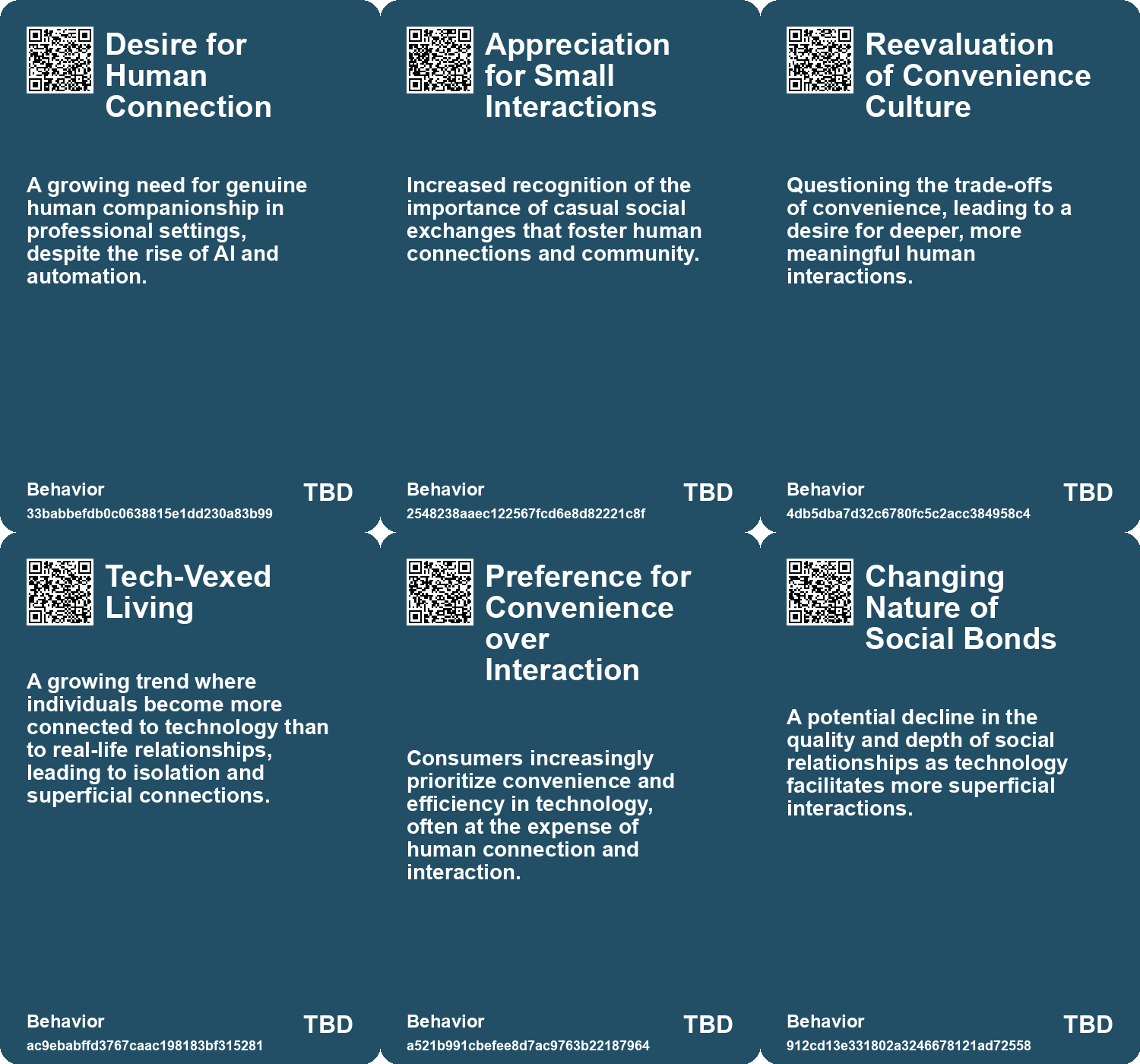
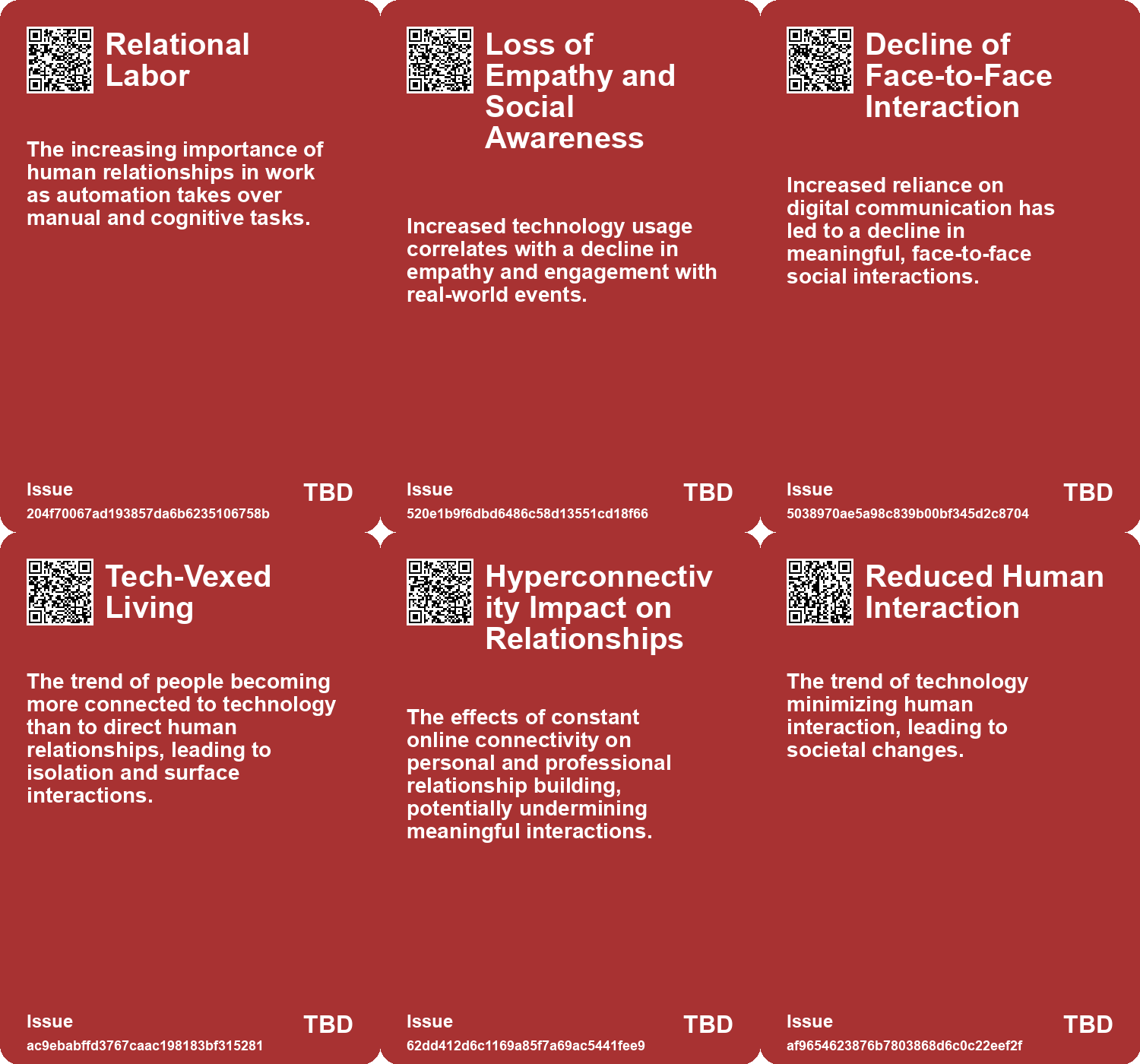
| 3 | Tech-vexed Living | The rise of technology leads to isolation from real human connections. | Shift from physical social interactions to technology-mediated relationships. | Greater emotional disconnection in relationships, leading to societal challenges. | Increased reliance on technology for communication and entertainment. |
| 4 | Societal Discontent with Automation | Rising awareness of the consequences of automating human experiences. | Shift from humanistic to machine-dominated experiences in various aspects of life. | A reevaluation of technology’s role in personal fulfillment and authenticity. | Increasing concern about loss of humanity in favor of efficiency and automation. |
| 5 | Hyperconnectivity Impacting Networking | Hyperconnectivity is diminishing the quality of in-person networking experiences. | Moving away from meaningful connections to superficial online interactions. | Networking events may prioritize digital engagement over personal connections, changing their nature. | The desire to remain connected online during in-person events drives this change. |
| 6 | Social Media as a Simulated Connection | Social media fosters a false sense of connection while reducing real interaction. | Transition from genuine social interactions to superficial online engagements. | In 10 years, social media might exacerbate feelings of isolation and dissatisfaction. | The pursuit of convenience and connectivity fuels the growth of online platforms. |
| 7 | Shift in Communication Norms | Reduction of interactions to numbers affects human connections. | From rich, meaningful interactions to quantifiable, superficial engagements. | Potential decline in deep interpersonal relationships and communication skills. | The rise of social media and its emphasis on metrics over personal connection. |
| 8 | Attention Economy | Human attention is commodified, impacting personal and societal relationships. | Shift from meaningful engagement to superficial connectivity and availability. | In ten years, personal relationships may suffer due to a continued prioritization of digital engagement. | Tech companies aim to maximize user engagement for profit, often at the cost of quality interactions. |
| 9 | Mental Health Concerns | Isolation and loneliness are rising due to digital technology’s influence. | Shift from community engagement to individual isolation exacerbated by technology. | In ten years, mental health issues related to loneliness may become a major public health crisis. | Digital connectivity replaces physical interactions, leading to increased feelings of alienation. |
Concerns
| name | description | |
|---|---|---|
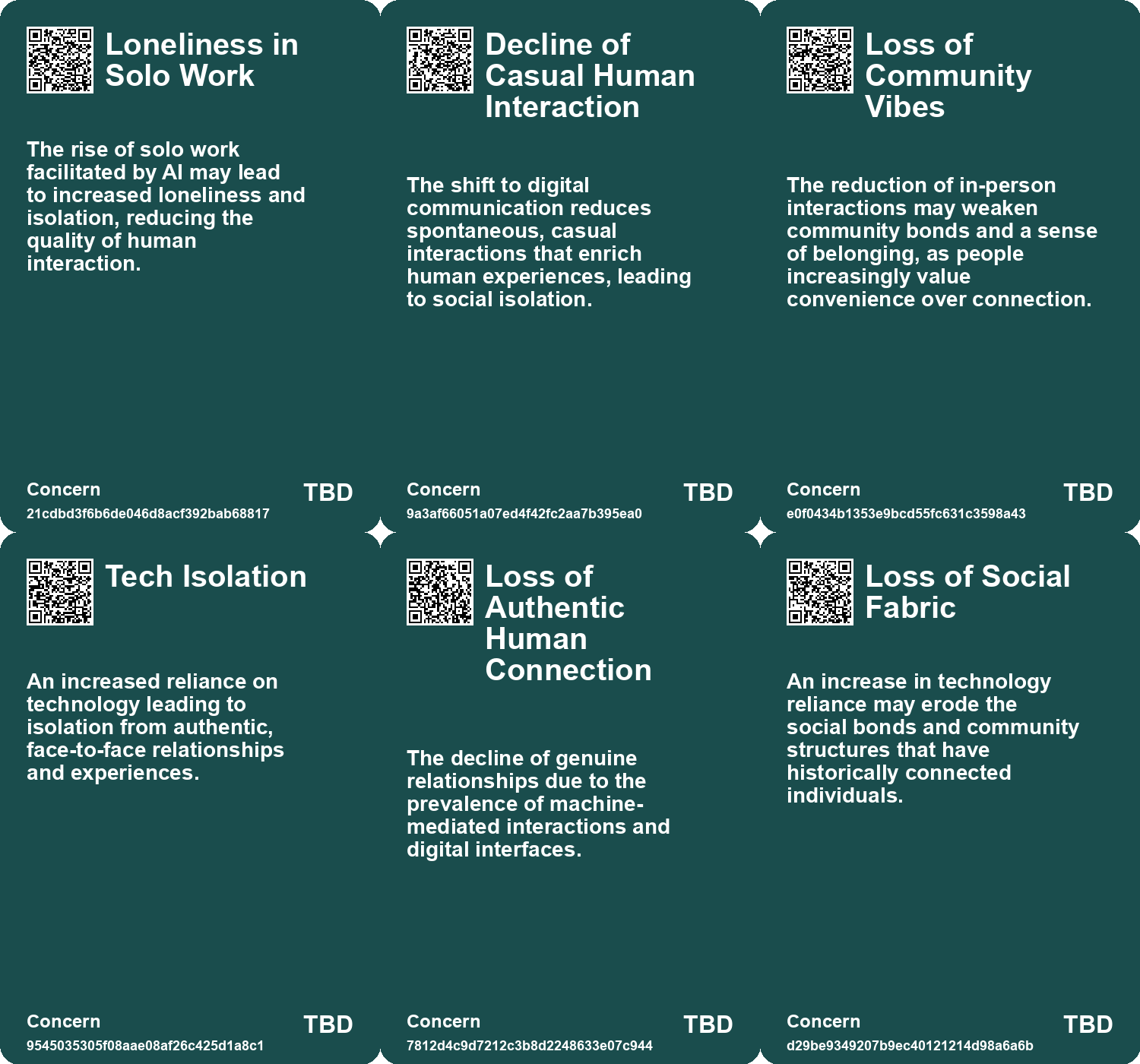
| 0 | Loneliness in Solo Work | The rise of solo work facilitated by AI may lead to increased loneliness and isolation, reducing the quality of human interaction. |
| 1 | Decline of Casual Human Interaction | The shift to digital communication reduces spontaneous, casual interactions that enrich human experiences, leading to social isolation. |
| 2 | Loss of Community Vibes | The reduction of in-person interactions may weaken community bonds and a sense of belonging, as people increasingly value convenience over connection. |
| 3 | Tech Isolation | An increased reliance on technology leading to isolation from authentic, face-to-face relationships and experiences. |
| 4 | Loss of Authentic Human Connection | The decline of genuine relationships due to the prevalence of machine-mediated interactions and digital interfaces. |
| 5 | Loss of Social Fabric | An increase in technology reliance may erode the social bonds and community structures that have historically connected individuals. |
| 6 | Loss of Offline Experience | The decline in people who remember life before the internet may result in a loss of perspective on human interactions. |
| 7 | Technological Dependency | The growing reliance on technology may diminish critical thinking, focus, and personal autonomy, leading to a ‘sickness’ in human relationships. |
| 8 | Loss of Human Connection | The shift toward automation and digital interfaces can lead to a reduced sense of community and interpersonal relationships. |
| 9 | Value Misalignment | AI technology may lead society away from human values and authentic connections, necessitating urgent reassessment. |
Cards
Concerns
Behaviors
Issue
Technology
Links
- Exploring Technology’s Impact: Insights from Michael Harris on Life Before and After the Internet
- The Vital Role of Relational Labor in an Automated World
- Embracing Human Connection: Lessons from Kurt Vonnegut on Life’s Simple Pleasures
- Navigating the Future of Work: Balancing AI, Humanity, and Connection in an Evolving Landscape
- The Cognitive Costs of AI: Are We Sacrificing Our Mental Abilities for Convenience?
- The Crisis in Education: Students as Victims of Smartphone Addiction and Tech Overreach
- Exploring the Modern Entertainment Landscape and Its Societal Implications
- AI’s Impact on Society: Job Displacement and the Need for Retraining
- Addressing the Social Fitness Crisis: The Need for Connection in Modern Society
- Exploring Goal Flexibility and AI’s Impact on Creativity and Connection
- The Dangers of Relying on AI Chatbots for Companionship and Connection
- Exploring the Risks of Heavy Chatbot Use on Mental Health and Social Interactions
- The Impact of the Internet and AI on Human Cognition and Productivity
- The Decline of Human Thinking in the Age of AI: A Call for Educational Reform
- The Diminishing Role of Human Interaction in Modern Technology and Its Societal Implications
- The Impact of Continuous Partial Attention on Networking and Relationships in a Digital World
- The Emotional Impact of Losing Access to Virtual Worlds in Gaming
- The Role of Social-Emotional AI: Bridging or Widening the Gap in Human Connection?
- The Emotional Impact of Virtual Reality and AI in Grieving Process
- Reimagining Social Systems: The Role of AI in Enhancing Human Care and Management Consulting
- The Impact of AI on Wages and Human Adaptation in the Workforce
- The Importance of Authentic Experiences and Awe in a Tech-Dominated World
- Understanding Polarization: Healing Our Relationship with Technology and Embracing Diverse Perspectives
- Exploring the Dangers of Outsourcing Happiness and Personal Fulfillment in Modern Society