Futures
Topic: Skepticism towards Scientific
Summary
The ongoing debate between free will and determinism remains a focal point in contemporary discussions about human agency. The complexities of this debate are highlighted by neuro-determinists who argue that human decisions stem solely from neurological processes, challenging traditional notions of individual responsibility. This perspective raises significant questions about justice and societal institutions, as seen in the works of thinkers like Robert Sapolsky and Gregg Caruso. The philosophical implications of free will are further explored through literature, notably the writings of Fyodor Dostoevsky, which emphasize the importance of moral choice.
Technological advancements are scrutinized through the lens of the Techno-Optimist’s Fallacy, which posits that all technological progress is inherently beneficial. This fallacy is exemplified by the historical context of nuclear energy and its potential to address environmental issues, despite the backlash from anti-nuclear movements. The dangers of technology are also evident in the rise of harmful products, such as fentanyl and ultra-processed foods, underscoring the need for critical evaluation of technological impacts.
The exploration of unconventional ideas spans various fields, including quantum mechanics, economics, and neuroscience. The implications of quantum theories, such as the ‘many worlds’ interpretation, and the economic consequences of brain simulation are discussed. These ideas raise philosophical questions about existence and governance, suggesting a future where technology shapes societal structures.
The rise of skepticism towards digital media, termed “deep doubt,” reflects a growing concern about the authenticity of information in an age dominated by AI-generated content. This skepticism is compounded by the phenomenon of the “liar’s dividend,” where deceptive technologies undermine trust in genuine evidence. Public figures have contributed to this narrative, further complicating the landscape of media reliability.
Education systems are adapting to combat misinformation, as seen in Finland’s integration of digital literacy and fact-checking into school curricula. This approach emphasizes critical thinking and equips students with the skills to navigate online media effectively. The success of these initiatives highlights the importance of teacher training and support in fostering a culture of skepticism and informed decision-making.
The evolving landscape of scientific research is marked by the emergence of autonomous AI systems capable of conducting independent research. While these innovations promise to transform the research community, they also pose threats to traditional academic roles. The implications of AI in science extend to the quality of research outputs and the future of knowledge dissemination.
Finally, the intersection of science fiction and policy discussions underscores the genre’s role in shaping public discourse around technology and its implications. By engaging the imagination, science fiction fosters empathy and encourages dialogue about the future. This narrative approach is essential for addressing the moral complexities of contemporary challenges, including climate change and technological advancements.
Seeds
| name | description | change | 10-year | driving-force | |
|---|---|---|---|---|---|
| 0 | Cultivation of Anti-Establishment Sentiment | Skepticism toward doctors and healthcare fuels anti-establishment views. | Incremental doubt toward medical professionals to open disdain and rejection. | A polarized public health environment, leading to differentiated health practices. | Erosion of trust in scientific and medical communities post-pandemic. |
| 1 | Skepticism Towards AI | A growing public skepticism towards AI is emerging, moving from admiration to criticism. | Shift from excitement about AI to a more critical and skeptical approach among the public. | In 10 years, critiques of AI may be mainstream, affecting policies and AI development choices. | Public disappointment in AI performance and ethical implications is driving skepticism. |
| 2 | Self-Deception in Truth-Seeking | Most humans are self-deceived about their rational truth-seeking abilities. | From belief in rationality to awareness of widespread self-deception. | In ten years, this insight may lead to more critical approaches to truth and belief systems. | Cognitive psychology insights drive awareness of self-deception in human behavior. |
| 3 | Conspiracy Theories Amplification | Rise in conspiracy theories fueled by AI-generated media and deep doubt. | Shift from skepticism towards specific events to broader distrust in all media narratives. | Conspiracy theories may become mainstream, affecting public trust in institutions and media. | The intersection of technology, misinformation, and social media dynamics. |
| 4 | Distrust in Historical Experts | Increasing skepticism towards professional historians and their interpretations of the past. | Transition from reliance on expert historians to acceptance of amateur interpretations of history. | In 10 years, historical understanding may be primarily influenced by social media personalities rather than trained historians. | A broader societal trend of questioning expert authority, fueled by misinformation and conspiracy theories. |
| 5 | Literary Criticism of Science Fiction | Criticism of science fiction is often written by outsiders, leading to misunderstandings. | The shift from external criticism to internal appreciation of science fiction’s unique qualities. | In 10 years, more informed criticism may emerge from within the science fiction community. | The growing number of educated readers and writers in the genre will enhance critical discourse. |
| 6 | Philosophical Reassessment of Free Will | Ongoing debates about the nature of free will and moral responsibility in light of scientific findings. | From acceptance of free will as a foundational concept to questioning its validity based on determinism. | Philosophical frameworks may shift towards compatibilism or other models reconciling free will with determinism. | Growing body of scientific literature suggesting deterministic views of human behavior. |
| 7 | Literature as a Reflection of Consciousness | Literary works are increasingly used to explore and critique scientific perspectives on human behavior. | Shift from purely empirical analysis to incorporating subjective experiences in understanding behavior. | Literature may play a key role in shaping public discourse on morality and individual agency in society. | Desire for a deeper understanding of human experience beyond scientific objectification. |
| 8 | Increased Skepticism of Scientific Objectivity | Rising awareness of the limitations and biases inherent in scientific research and its interpretations. | From viewing science as an objective truth to recognizing the subjective influence of researchers. | Expectations for scientific research may include greater transparency and acknowledgment of biases in methodology. | Calls for accountability and ethical considerations in how science interacts with human life. |
| 9 | Skepticism about Technological Solutions | There is skepticism about the sufficiency of technological solutions to climate change. | Transition from blind faith in technology to critical evaluation of its potential and limitations. | Technological solutions may be integrated with deeper societal changes rather than being standalone fixes. | Growing recognition of the limitations of technology in addressing complex ecological issues. |
Concerns
| name | description | |
|---|---|---|
| 0 | Public Trust in Scientific Research | The proliferation of low-quality AI-generated research may erode public trust in the reliability of scientific findings. |
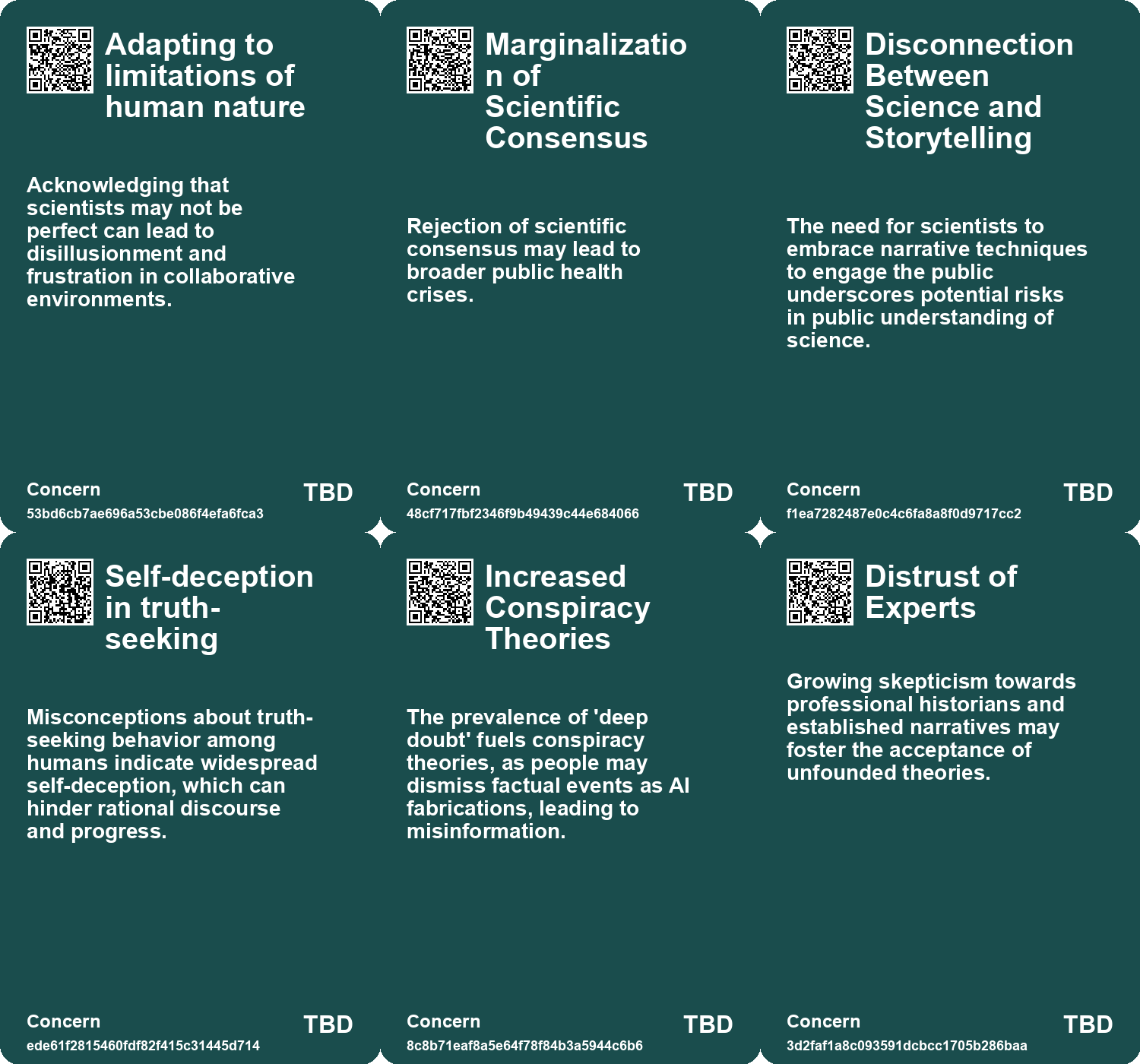
| 1 | Adapting to limitations of human nature | Acknowledging that scientists may not be perfect can lead to disillusionment and frustration in collaborative environments. |
| 2 | Marginalization of Scientific Consensus | Rejection of scientific consensus may lead to broader public health crises. |
| 3 | Disconnection Between Science and Storytelling | The need for scientists to embrace narrative techniques to engage the public underscores potential risks in public understanding of science. |
| 4 | Self-deception in truth-seeking | Misconceptions about truth-seeking behavior among humans indicate widespread self-deception, which can hinder rational discourse and progress. |
| 5 | Increased Conspiracy Theories | The prevalence of ‘deep doubt’ fuels conspiracy theories, as people may dismiss factual events as AI fabrications, leading to misinformation. |
| 6 | Distrust of Experts | Growing skepticism towards professional historians and established narratives may foster the acceptance of unfounded theories. |
| 7 | Neglect of Individual Agency in Scientific Research | The scientific focus on objectifying human behavior risks overshadowing the subjective experience of free will and personal responsibility. |
| 8 | Cultural Resistance to Scientific Determinism | Public reception of neuroscientific claims on free will may create division between scientific communities and traditional moral values. |
| 9 | Philosophical Paradoxes of Scientific Inquiry | The contradictions in scientific naturalism raise questions about the nature of reason and persuasion in a deterministic world. |
Cards
Concerns
Behaviors
Issue
Technology
Links
- Reflections on Paperlessness and Personal Archives in a Digital Age
- Exploring Humanity Through Science Fiction: The Journey of Astrobiologist Seven Rasmussen
- Exploring the Future of Knowledge in the Age of AI: From Peer Review to NotebookLM
- The Rise of Science Fiction: J.G. Ballard’s Vision for Literature and Society
- Exploring Wild Ideas: Quantum Mechanics, Brain Simulation, and Economic Growth
- Navigating the Challenges of Futures Work: The Importance of Imagination over Forecasting
- The Freedom Summit: A Rallying Cry for Anti-Vaccine Sentiments and Medical Distrust
- Harnessing Science Fiction as a Tool for Engaging Science and Technology Policy Discussions
- Exploring the Rise of ‘Deep Doubt’ Amidst AI-Generated Media Content
- Finland’s Innovative Approach to Combating Fake News Through Education
- Embracing Sensitivity: A Journey Through Personal and Environmental Awareness
- Exploring Attitudes Towards Climate Change and the Planetary Crisis Through the Polak Game
- Exploring Free Will and Determinism in Science and Literature
- Understanding the Techno-Optimist’s Fallacy and its Implications for Technology Regulation
- Embracing Uncertainty: Strategies for Navigating Life’s Unknowns
- The Transition from Mathematical Models to Computer Simulations in Theoretical Physics
- Christof Koch and David Chalmers Conclude 25-Year Wager on Consciousness Discovery
- Exploring the Complexities of Consciousness: Insights from Recent Scientific Wagers and Collaborations
- The Evolution and Impact of Historical Revisionism Through Pseudohistory
- Navigating Unconventional Paths in Science: Advice for Academic Misfits
- The AI Scientist: A Revolutionary Autonomous AI for Scientific Research
- Shifting Perspectives: The Growing Skepticism Towards AI and Its Implications
- The Shift from Academia to Industry: Young Life Scientists Seek Better Opportunities
- Understanding Polarization: Healing Our Relationship with Technology and Embracing Diverse Perspectives